
Pick epoxy for garages, workshops, and any floor that takes hot tires, dropped tools, or chemical spills. Pick stain for patios, entryways, and living spaces where you want a natural, one-of-a-kind look with less upfront prep. Epoxy costs more to install and needs mechanical grinding, but stain requires resealing every two to five years to keep its protection intact.
TL;DR:
- Epoxy finishes are ideal for garages and workshops due to their high resistance to abrasion, chemicals, and hot tires, lasting up to 15 years between recoats.
- Concrete stain is better suited for patios and living spaces because it provides a natural look and requires resealing every two to five years to maintain protection.
- Proper surface preparation, including mechanical grinding and moisture testing, is crucial for long-lasting results and is often overlooked in cheaper or DIY installations.
- Epoxy tends to be more expensive initially but offers better durability, while stain costs less upfront but needs more frequent resealing for ongoing protection.
- Both finishes require good ventilation during application, and samples should be tested on your actual slab to prevent disappointment with color or sheen differences.
Table of Contents
- Concrete Stain vs Epoxy: A Quick Side-by-Side
- How Do Stain and Epoxy Look Different on Concrete?
- Which Finish Holds Up Better Over Time?
- What Does Proper Installation Actually Require?
- How Much Does Each Finish Cost Over Time?
- How Do You Maintain and Repair Each Finish?
- Which Rooms Suit Stain, and Which Suit Epoxy?
- What Safety and Ventilation Issues Should You Know About?
- What Should You Check Before Signing a Quote?
- What Does a Properly Prepped Floor Actually Look Like?
- My Take After Weighing Both Options
- Ready for a Professionally Installed Floor?
- Sources
- FAQ
Concrete Stain vs Epoxy: A Quick Side-by-Side
Stain and epoxy solve different problems because they work in fundamentally different ways. Stain is a penetrating dye that soaks into the concrete and becomes part of the slab. Epoxy is a two-part resin that cures into a hard film sitting on top of the concrete. That distinction drives almost every other difference between them.
- How it works: Stain penetrates and colors the concrete itself; epoxy forms a bonded surface coating.
- Appearance: Stain gives variegated, marble-like, or earthy tones that follow the slab’s natural texture; epoxy delivers uniform color, metallic swirls, or full decorative flake broadcasts.
- Durability: Epoxy resists abrasion and chemicals better; stain resists peeling because there’s no film to lift, but its surface protection depends entirely on the sealer.
- Prep and installation: Stain needs cleaning, degreasing, and sometimes etching; epoxy needs mechanical grinding or shot blasting plus moisture testing before anything touches the floor.
- Maintenance: Stain gets resealed every 2 to 5 years; epoxy typically gets recoated every 5 to 15 years depending on traffic.
- Cost: Stain runs roughly $2 to $8 per square foot installed, epoxy $3 to $12, with decorative flake and metallic systems at the top end.
For a quick room match: garages and workshops lean epoxy, patios and living areas lean stain, and basements depend on how much moisture is coming through the slab.
How Do Stain and Epoxy Look Different on Concrete?
The visual difference comes down to what’s actually happening at the surface. Acid stains trigger a chemical reaction with the lime in the concrete, and that reaction produces variegated, marble-like coloring that’s never quite the same twice, even on the same slab. Water-based stains skip the chemical reaction and give you a wider, more predictable color palette, though they sit slightly more on the surface than true acid stains do.
Either way, whatever is already in your concrete shows through. Aggregate, trowel marks, old patches, curing blotches. Stain doesn’t hide flaws; it highlights them. If your slab has a rough finishing history, that’s worth knowing before you commit to a color.
Epoxy works the opposite way. Because it’s a coating, it can bury imperfections entirely and give you a completely uniform look, or go the other direction with texture and pattern: solid colors, multi-color flake blends, metallic pigments that create a three-dimensional, almost liquid appearance, and a range of gloss levels from satin to high shine. Anti-slip additives can go into the topcoat for stairs, entries, or pool decks.
Neither finish should be chosen from a photo alone. Lighting, slab porosity, and even the age of your concrete change how a color reads in real life. A sample panel poured or applied on your own slab lets you see the actual color, sheen, and texture under your garage lights or your patio’s afternoon sun, not a showroom’s. Homeowners who skip this step are the ones who end up disappointed by a stain that looked warm gray in a brochure and turned out olive on their driveway.
Which Finish Holds Up Better Over Time?
Epoxy wins on raw toughness. A properly installed epoxy system resists abrasion, hot tire pickup, and most household chemicals well enough to handle a daily-use garage or workshop without flinching. Oil, brake fluid, coolant, salt from winter boots. all of it sits on the surface and wipes away instead of soaking in. The catch is that epoxy can delaminate if the slab underneath wasn’t mechanically profiled or if moisture is migrating up through the concrete. When you see epoxy peeling in sheets, that’s almost always a prep failure, not a product failure.
Stain plays a different game entirely. Because the color is part of the slab, it physically cannot peel or delaminate the way a coating can. What stain doesn’t have is a protective film of its own. Its resistance to abrasion, chemicals, and stains depends completely on the sealer applied over it, and that sealer wears down with foot traffic, UV exposure, and time. A stained patio that sees bare feet and the occasional spilled drink will look great for years. A stained garage floor that takes hot tires and dripping oil pans will show wear at the sealer level much faster than epoxy would.
Think about the actual use case. Hot tires transfer plasticizers that can soften some sealers over time, oil spills sit and stain unsealed or under-sealed concrete almost immediately, and heavy foot traffic in a mudroom will burnish a sealer’s sheen unevenly within a season or two. None of that is a dealbreaker. It’s just a reason to match the finish to what the floor actually has to survive.
What Does Proper Installation Actually Require?
Long-term performance comes down almost entirely to what happens before any color or coating touches the slab. Surface preparation is the single biggest factor in whether a finish lasts five years or fifteen, and stain and epoxy demand different prep routines.
- Clean and degrease the slab. Both finishes fail on top of old oil, grease, or sealer residue, so this step is non-negotiable regardless of which product goes down.
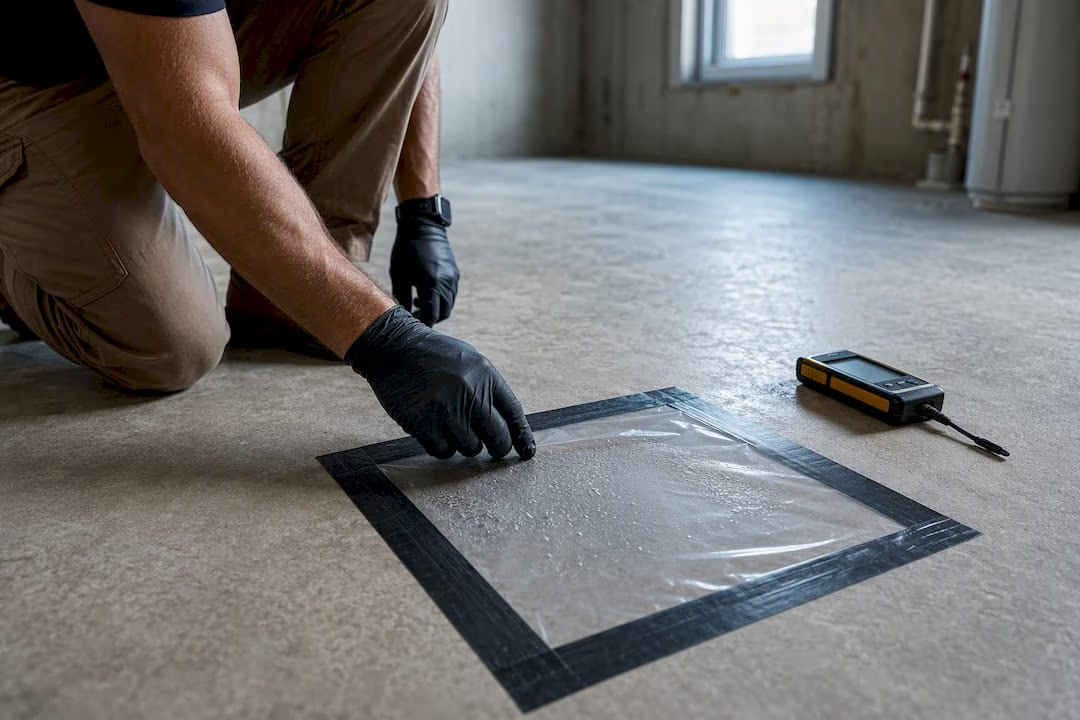
- Test for moisture. Epoxy especially needs a moisture vapor test before installation; trapped moisture under a film coating is the leading cause of bubbling and delamination.
- Repair cracks and spalling. Any structural or cosmetic damage gets addressed before staining or coating, since both finishes will telegraph a crack right through the surface.
- Profile the surface for epoxy. Mechanical grinding or shot blasting opens the concrete’s pores so epoxy has something to physically grip. Skipping this step is the number one reason DIY epoxy kits fail in real garages.
- Etch or open the surface for stain, if needed. Dense or troweled-smooth slabs sometimes need light mechanical or chemical profiling so stain can penetrate evenly.
- Apply and neutralize stain, or prime and coat epoxy within pot life. Acid stains need neutralizing before sealing; epoxy has to be mixed and applied within its working window, and temperature and humidity both affect cure time.
- Control the cure environment. Dust, humidity, and temperature swings during epoxy cure can cause blush, tackiness, or poor adhesion.
Watch for contractors who skip grinding on a garage floor, quote a job without ever running a moisture test, or promise a same-day cure in cold, damp conditions. Those are the shortcuts that show up as failures within a year, and professional two-part epoxy systems consistently outperform single-can, big-box kits precisely because the prep and materials are built for it.
How Much Does Each Finish Cost Over Time?
Installed pricing gives you the first number, but it’s not the whole story. Stained concrete typically runs $2 to $8 per square foot, while epoxy runs $3 to $12, with the spread driven by how much prep the slab needs and whether you’re adding decorative flake, metallic pigment, or a polyaspartic topcoat. A basic solid-color epoxy sits near the low end; a full broadcast flake system with a UV-stable topcoat sits at the top.
The real cost comparison happens over a decade or two, not on installation day. Stain needs resealing every 2 to 5 years to maintain its protection, and each reseal is a smaller expense than the original install but it adds up. Epoxy typically goes 5 to 15 years between recoats depending on traffic and the topcoat used, which means fewer service calls but a bigger bill when a recoat is due.
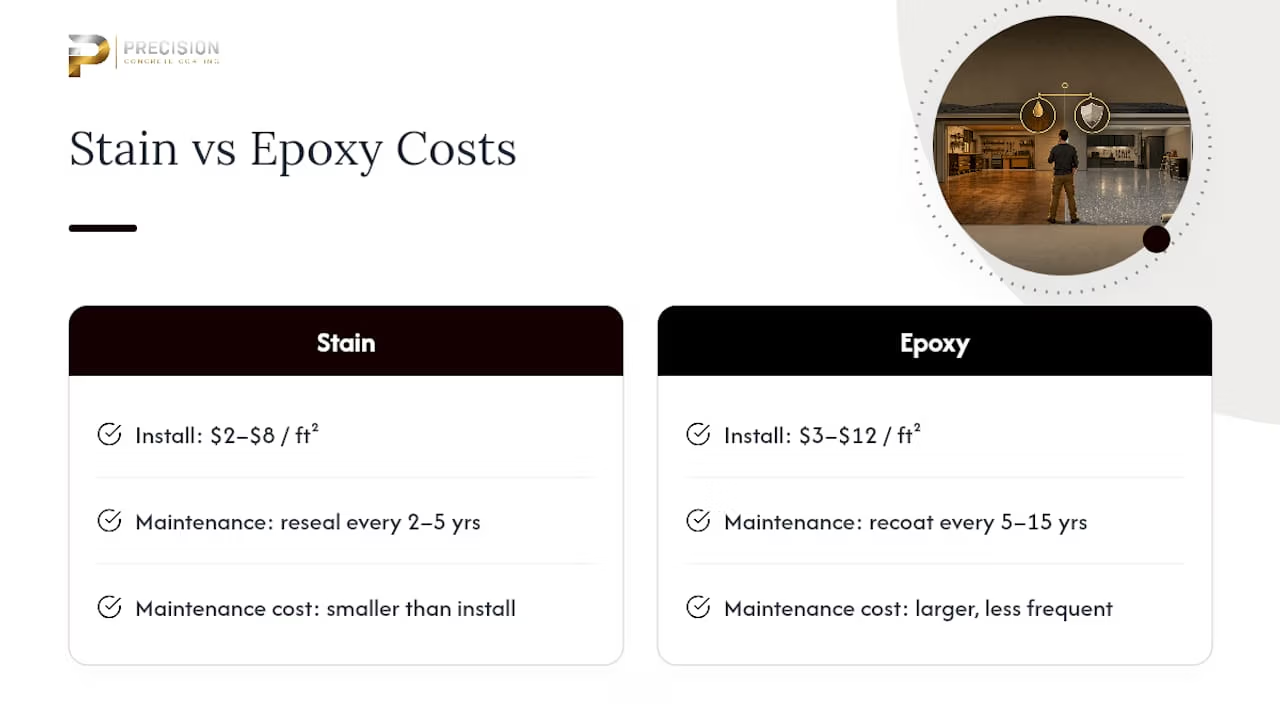
If your floor sees light, decorative use, stain’s lower install cost and manageable reseal cycle usually make sense. If it’s a daily-use garage, workshop, or anything exposed to chemicals and heavy impact, spending more upfront on epoxy tends to pay off in fewer repairs and less downtime later.
How Do You Maintain and Repair Each Finish?
Routine cleaning is simple for both. Sweep or dust mop regularly, then damp mop with a pH-neutral cleaner. Harsh acids and high-alkaline strippers can etch stain sealers and cloud epoxy topcoats, so skip anything labeled heavy-duty degreaser unless a manufacturer specifically approves it for your finish. For stubborn oil stains on garage or driveway concrete, a dedicated degreaser applied promptly works far better than scrubbing after the stain sets.
Small chips or scratches in epoxy can usually be spot-patched, but a scuffed or dulled reseal on stained concrete is a straightforward DIY-adjustable fix if you catch it early. Oil spots on unsealed or worn stain are harder to lift and sometimes mean an early reseal. Once you see peeling, wide delamination, or sealer failure across large areas, that’s a full recoat or replacement job, not a touch-up.
Walk the floor every few months, snap a photo, and jot down the date of your last reseal or recoat. That small habit tells you exactly when maintenance is due before a small problem turns into a full redo.
Which Rooms Suit Stain, and Which Suit Epoxy?
Garages and workshops are epoxy’s home turf. Epoxy is the better call wherever chemical resistance, impact resistance, and easy cleanup top the priority list, and that’s exactly what a daily-driver garage demands.
Living areas, entryways, and patios usually favor stain, or stain paired with a UV-rated sealer, because the natural variegated look reads as flooring rather than a coating. Polished concrete is worth considering in these spaces too, if you want durability without a stained color pattern. Outdoor patios in particular benefit from stain’s better UV stability compared to unprotected epoxy.
Basements and laundry rooms come down to moisture. A basement with a history of dampness needs that addressed before either finish goes down, since trapped moisture will eventually undermine epoxy’s bond or push through a stain sealer from underneath.
What Safety and Ventilation Issues Should You Know About?
Acid stains produce fumes during application and neutralization, and epoxy systems release odors during mixing and cure, so both call for good ventilation, gloves, and eye protection whether you’re hiring it out or watching the process. Open garage doors and running fans during application isn’t optional in either case.
Outdoors, UV exposure is the bigger long-term risk. Many epoxy formulations yellow over time under direct sun unless a UV-stable topcoat, typically polyaspartic or polyurethane, is applied over the base coat. Stain with an outdoor-rated sealer generally holds its color better in sun-exposed settings.
And before any epoxy goes down over an existing slab, a moisture vapor test isn’t optional: it’s the difference between a floor that bonds for a decade and one that bubbles within a year.
What Should You Check Before Signing a Quote?
Before you sign anything, walk through this list with your contractor:
- Confirm the floor’s intended use: daily-driver garage, occasional-use patio, or a basement with moisture history.
- Ask what condition the substrate is in and whether cracks or spalling need repair first.
- Request the actual moisture test results, not just a verbal assurance.
- Ask for proof of mechanical prep, grinding equipment used, dust containment method, and profile achieved.
- Insist on a sample patch applied to your own slab before full installation.
- Get the warranty terms and recoat or reseal schedule in writing.
Red flags include vague answers about prep, no moisture testing offered at all, no written warranty, and timelines that promise a full cure faster than the material’s own data sheet allows. If a quote sounds too fast and too cheap for the square footage, it usually is.
Pro Tip: Always ask for a sample panel on your own concrete, not a showroom sample, and photograph it under your actual garage lighting or outdoor sun. Colors and sheens shift dramatically between fluorescent light and daylight.
What Does a Properly Prepped Floor Actually Look Like?
Precision Concrete Coating in Conroe TX builds every project around the prep work this article keeps circling back to: diamond grinding, crack and pitting repair, and moisture mitigation before a drop of coating goes down. That approach pairs decorative flake broadcast and UV-stable polyaspartic topcoats with a 15-year residential warranty, backing the same durability and prep standards covered above. If you want to see how that plays out on an actual project, the Granger Pines garage floor coating case study documents the process from bare slab to finished floor.
My Take After Weighing Both Options
If you take one thing from this comparison, take this: the finish matters less than the prep underneath it. I’d rather see a homeowner install a basic stain over a properly ground, moisture-tested slab than a premium metallic epoxy over concrete nobody bothered to test. Get a sample panel poured on your own floor before you decide anything, and if you’d rather skip the guesswork entirely, a professional can document that prep for you.
— William
Ready for a Professionally Installed Floor?
If reading through moisture testing, grinding profiles, and recoat schedules made you realize this isn’t really a weekend project, that’s the honest takeaway. Some contractors handle the entire process for homeowners in the Conroe and North Houston area, including crack and pitting repair, mechanical diamond prep, decorative flake broadcast, and UV-stable polyaspartic topcoats, often backed by a residential warranty that many stain-only or big-box coating jobs do not offer.

You don’t have to guess whether your slab needs moisture mitigation or how much prep your garage actually requires. Request a free estimate and find out exactly what your floor needs, or check how soon you can park on a new garage floor coating once the project wraps.
Sources
- Acid Stain vs Epoxy: A Comprehensive Guide for Concrete Finishes – Floor Chem Depot
- Stained Concrete vs Epoxy Flooring (2026 Comparison) | ELSO Contracting
- Concrete Stain vs. Epoxy Paint: What’s Best for Your Garage Floor? (Santa Fe Concrete Contractors)
FAQ
What Are the Downsides of Staining Concrete?
Stain relies entirely on its sealer for protection, so it needs resealing every 2 to 5 years and won’t resist heavy chemical exposure or abrasion as well as epoxy.
What Is the Best Coating for Outdoor Concrete?
Stain with a UV-rated sealer generally outperforms epoxy outdoors, since many epoxy formulations yellow in direct sun unless finished with a UV-stable polyaspartic or polyurethane topcoat.
What Are the Drawbacks of Using Concrete Epoxy?
Epoxy can delaminate if the slab wasn’t mechanically ground and moisture tested first, and standard formulations can yellow under UV exposure without a protective topcoat.
How Many Years Does Concrete Stain Last?
The stain color itself lasts as long as the slab since it’s part of the concrete, but the protective sealer over it typically needs reapplication every 2 to 5 years depending on traffic.
2 Responses