Pitting is shallow surface pockmarking, usually no deeper than a quarter inch, caused by finishing errors or weak surface paste. Spalling is bigger and more serious: chips or flakes that break away and can expose the aggregate or the rebar underneath. If you see rust stains or cracks tracking in a line, you’re likely looking at spalling driven by corroding steel, and that floor needs real repair and a moisture check before any coating goes down.
TL;DR:
- Spalling deeper than a quarter inch or covering more than 10 to 20 percent of the surface area requires professional repair and assessment.
- Coating over unrepaired spalling or pitting will likely result in delamination and early failure, especially if moisture or rusting steel is involved.
- Proper repair involves mechanical grinding, applying polymer-modified mortar, and confirming the slab is dry with moisture testing before coating.
- Small, superficial pitting under an eighth of an inch can be DIY patched, but extensive damage warrants expert intervention.
- Regular maintenance, such as resealing and addressing drainage issues, is crucial to prevent recurrence of pitting and spalling.
Table of Contents
- Pitting vs Spalling: How to Tell Them Apart by Sight and Touch
- What Causes Pitting and Spalling, and Why It Matters for Your Slab
- When to DIY and When to Call a Concrete Repair Pro
- Repairing and Prepping a Damaged Floor for a Garage Coating
- Keeping Pitting and Spalling From Coming Back
- Why We Won’t Skip the Grinder, Even When Homeowners Ask Us To
- Get a Straight Answer on Your Garage Floor Before You Coat It
- Sources
- FAQ
Pitting vs Spalling: How to Tell Them Apart by Sight and Touch
You don’t need a lab to sort this out. Grab a flashlight, a screwdriver, and five minutes.
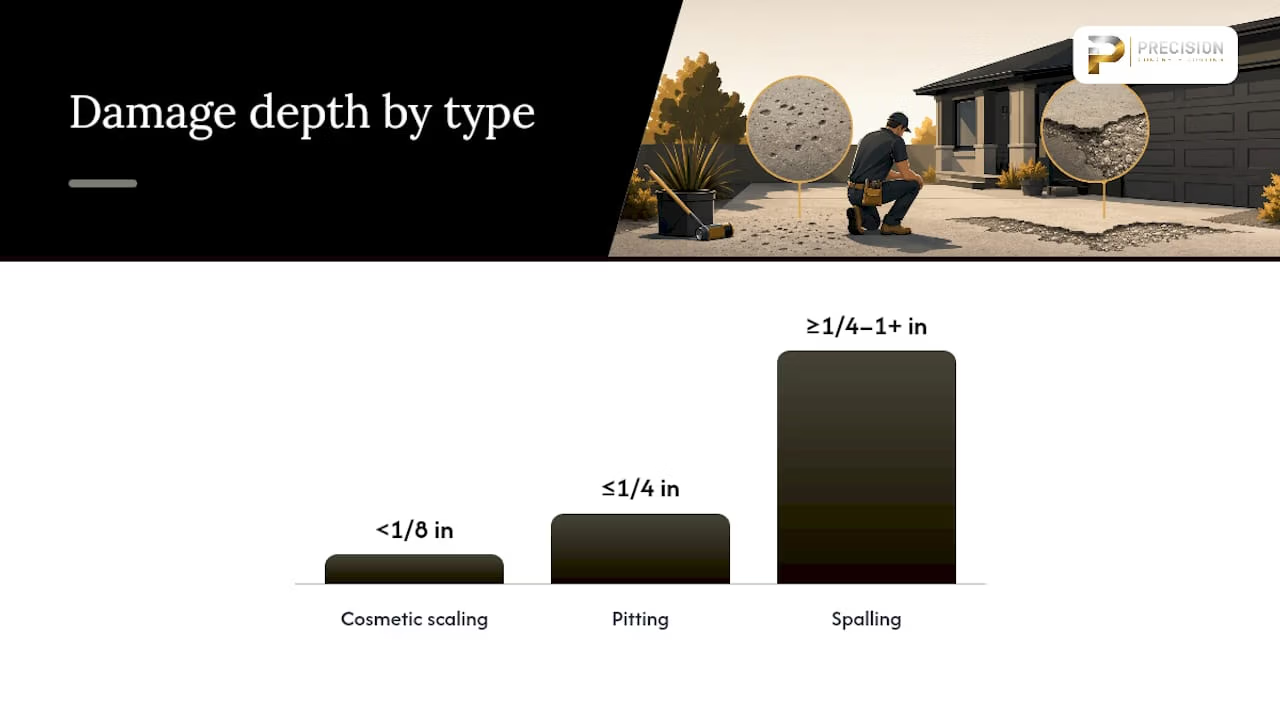
Pitting shows up as small, shallow craters scattered across the surface, typically under a quarter inch deep. It looks like the concrete has chicken pox: dozens of tiny voids where air bubbles or weak paste popped out during finishing. Spalling looks different. Pieces break away in chunks ranging from coin-sized to palm-sized, and the damaged spots run 1/4 inch to a full inch deep or more.
Here’s your quick triage checklist:
- Check the pattern. Random, scattered craters usually mean pitting from finishing or air-entrainment issues. Damage that lines up in a straight or curved pattern often corresponds to underlying reinforcement layout.
- Look for rust staining. Orange or brown streaks bleeding from a crack or crater are a strong sign that steel reinforcement is corroding, which points to spalling, not simple pitting.
- Tap and probe. Tap the suspicious area with a hammer handle. A hollow, dull sound suggests delamination below the surface. Poke soft or crumbly spots with a screwdriver. If it sinks in easily, the concrete has lost integrity there.
- Measure depth. Anything under an eighth of an inch is likely cosmetic scaling. Past a quarter inch, especially with exposed aggregate, you’re dealing with structural spalling.
Photograph anything you find. It speeds up any conversation with a contractor later.
What Causes Pitting and Spalling, and Why It Matters for Your Slab
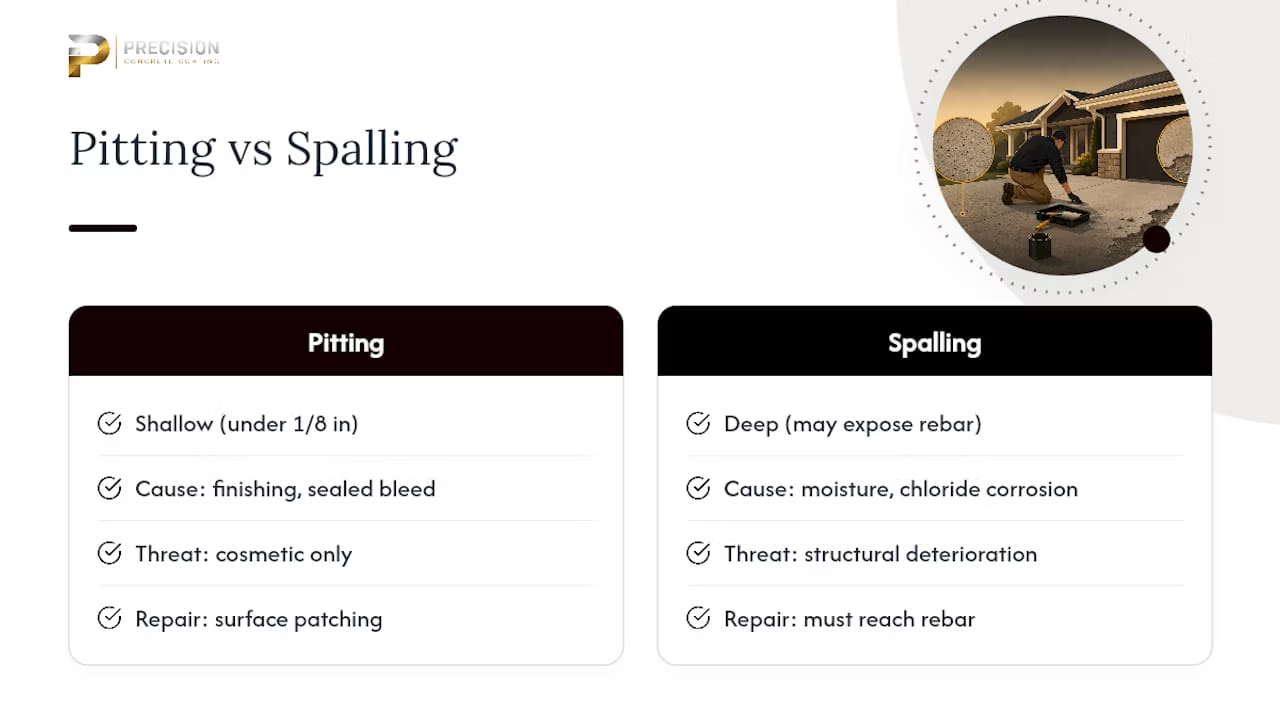
Pitting almost always traces back to how the concrete was finished. Trowel work that seals in too much bleed water, poor air-entrainment in the mix, or a rushed cure all leave a weak layer of paste at the surface. That paste flakes and pops under freeze-thaw cycles, foot traffic, or exposure to de-icing salts. It’s frustrating, but it’s rarely a threat to the slab’s strength.
Spalling has deeper roots. Moisture works its way through the concrete and reaches the steel rebar inside. Once chloride ions accumulate in the mix, often somewhere in the range of 1.2 to 2.0 pounds per cubic yard of concrete, corrosion can begin. Rusting steel expands, sometimes several times its original volume, and that expansion pushes outward until the concrete above it cracks and breaks free. Trapped bleed water and chemical attack from harsh cleaners or fertilizers can accelerate the same failure.
The difference matters because one is cosmetic and the other can be structural. Shallow scaling, generally under an eighth of an inch, is typically a finish problem you can live with or patch. Deep spalling that exposes rusted rebar signals ongoing deterioration that surface patching alone won’t fix, since the corrosion continues underneath any repair that doesn’t reach it.
There’s also a coating angle here. A coating bonds to the surface it’s given. Apply it over active corrosion or trapped moisture, and the bond fails from underneath, regardless of how good the topcoat is.
When to DIY and When to Call a Concrete Repair Pro
Not every flaw needs a contractor. Isolated pits or light surface scaling under an eighth of an inch, spread over a small area, are fair game for a do-it-yourself polymer patch or a thin resurfacing product. Follow the product instructions closely on cure time and surface prep, since a rushed patch just becomes tomorrow’s pit.
Call in a professional once the damage crosses these lines:
- Spalls deeper than a quarter inch, especially where you can see aggregate or steel.
- Damage covering more than 10 to 20 percent of the floor’s surface area.
- Any rust staining bleeding out of cracks or craters.
- Damage that runs in straight or curved lines, hinting at a rebar grid failing underneath.
A professional assessment goes further than a homeowner’s flashlight check. Contractors probe-map the damaged zones, grind test sections to gauge the surface profile, and run moisture vapor tests to see whether the slab is dry enough to coat. They’ll also inspect exposed rebar for how far corrosion has spread before recommending a repair sequence.
Before you call for a quote, gather the basics: total square footage of visible damage, photos of the worst spots, notes on any rust staining, and whether you’ve noticed recent moisture, condensation, or musty smells in the garage. That information gets you a far more accurate estimate on the first visit instead of a second trip.
Repairing and Prepping a Damaged Floor for a Garage Coating
Skipping steps here is the single most common reason garage floor coatings fail. Applying epoxy or polyaspartic over unrepaired spalling commonly leads to delamination within 12 to 24 months, because the coating never bonded to sound concrete in the first place.
A repair sequence that actually holds together looks like this:
- Remove everything weak. Contractors chase out spalled areas to solid, vertical shoulders and mechanically grind away loose or degraded concrete until they hit sound substrate. Skipping this step and just skimming a patch over damaged material is the fastest route to repeat failure.
- Rebuild with the right mortar. Polymer-modified repair mortar goes in during controlled lifts, built up and finished flush with the surrounding slab. This is not standard sand mix; it’s formulated to bond mechanically and chemically to old concrete.
- Grind and test. The floor gets diamond-ground to the concrete surface profile the coating manufacturer specifies, then cleared of dust. Moisture testing, using a vapor emission test or a simple plastic-sheet check, confirms the slab is dry enough before anything else touches it.
- Coat in layers. Primer goes down first, followed by decorative flake broadcast if you’ve chosen that look, then a UV-stable polyaspartic or epoxy topcoat seals the whole system.
New concrete needs roughly 28 days to cure before it’s ready for a moisture-sensitive coating. Coat too early and trapped moisture has nowhere to go but up through the new finish, causing bubbling or peeling within months.
Pro Tip: Ask any contractor to show you their moisture test results in writing before they schedule your coating date. A verbal “it’s fine” isn’t the same as a number on paper.
Precision Concrete Coating in Conroe TX backs this exact sequence, mechanical grinding, bonded repair mortar, and verified moisture readings, with a 15-year residential warranty. That’s not a marketing line so much as a bet on the prep work holding up.
Keeping Pitting and Spalling From Coming Back
A repaired floor is only as good as what happens to it afterward. Rinse off road salt, fertilizer, and pool chemicals promptly instead of letting them sit and soak in. If you need traction on ice, reach for sand instead of aggressive de-icing salts, which are one of the biggest drivers of both pitting and rebar corrosion.
Maintenance on a schedule beats maintenance by accident:
- Reseal bare concrete every 3 to 5 years, and check any existing coating for wear at least once a year.
- Follow your coating manufacturer’s recoating interval rather than waiting until you spot damage.
- Fix drainage problems around the garage slab and keep exterior water from pooling against the foundation.
- Recaulk expansion joints when they crack or pull away, since that’s a direct path for water underneath the slab.
Small habits like these are also what keep a warranty valid. Most coating warranties assume reasonable upkeep, not zero maintenance, and a little consistency now saves you a full garage floor coating maintenance overhaul later.
Why We Won’t Skip the Grinder, Even When Homeowners Ask Us To
I’ve seen plenty of DIY coating jobs fail within a year, and almost every one traces back to the same two shortcuts: skipping mechanical prep and never checking moisture. A coating sprayed over a lightly cleaned, still-damp slab looks fine on day one. By month six, it’s bubbling.
Mechanical diamond grinding and moisture testing aren’t optional extras. They’re the difference between a floor that lasts and one you’ll redo. If you’re vetting any contractor, ask three things: what were your moisture test results, what repair method are you using on damaged areas, and what does the warranty actually cover.
— William
Get a Straight Answer on Your Garage Floor Before You Coat It
Guessing whether your garage floor has pitting, spalling, or both is a bad way to spend a Saturday, and a worse way to spend your coating budget. Precision Concrete Coating in Conroe TX built its whole process around the opposite approach: mechanical diamond grinding, real moisture testing, and polymer-modified repair mortar before a drop of coating ever goes down, all backed by a 15-year residential warranty that most competitors skip straight past because proper prep costs time they’d rather not spend.

If your slab has visible pitting, rust-stained cracks, or flaking near the garage door track, start with an inspection instead of a guess. Our garage floor coatings page walks through the full-flake, solid-color, and metallic epoxy systems we install, and you can request a written estimate once we’ve seen the actual damage. If you already know pricing is your main question, our cost breakdown for garage and patio coatings covers the range homeowners typically pay per square foot before we ever step onsite.
Sources
- Concrete spalling repair guide
- Concrete spalling, pitting and repair (Gulf Coast)
- How to fix spalling garage concrete before coating
FAQ
Is Pitting or Spalling Worse for a Garage Floor?
Spalling is generally the more serious issue because it often involves corroding rebar and deeper structural loss, while pitting is usually a shallow, cosmetic finishing defect. Spalling deeper than a quarter inch or covering a large area typically needs professional repair before any coating goes on.
Can I Coat Over Pitted or Spalled Concrete Without Repairing It First?
No. Coating over unrepaired spalling commonly leads to delamination within 12 to 24 months, since the coating can’t bond properly to damaged or unstable concrete. Both conditions need mechanical grinding and, in the case of spalling, mortar rebuild before a coating system will hold.
How Do I Know if Rust Stains Mean My Slab Has Structural Damage?
Rust staining bleeding from a crack or crater usually means embedded steel is corroding, which points to spalling rather than surface pitting. That kind of damage rarely stays cosmetic and typically calls for professional assessment rather than a DIY patch.
How Much Does It Cost to Repair and Coat a Garage Floor?
Garage floor coating projects with Precision Concrete Coating in Conroe TX typically run $4.50 to $7.50 per square foot, depending on the coating system and the amount of repair the slab needs. Floors with extensive spalling may cost more upfront in prep work, but that investment is what keeps the coating from failing early.
How Long Should New Concrete Cure Before Coating?
New concrete generally needs about 28 days to cure before a moisture-sensitive coating can go on safely. Coating too soon traps residual moisture underneath the finish, which frequently causes bubbling or peeling within the first year.