Polished concrete is not automatically slippery, and it is not automatically safe. Its traction depends mostly on gloss level, whether the surface is wet, dirty or oily, what is on your feet, and how the floor is sealed and cleaned. Testing can compare one finish with another, but no number guarantees that nobody will ever slip. This guide explains what the standards say, how to read a test result, and how to add grip without giving up the look you wanted.
TL;DR
- Slip resistance of polished concrete changes with gloss level. In one industry test program it varied with gloss but not with how much aggregate was exposed.
- Wet testing is the number that matters. Ceramic tile is held to a wet DCOF of at least 0.42 for level interior areas, and that figure is a handy yardstick for comparing finishes.
- A test result is a comparison tool, not a promise. Footwear, spills, oil and dirt can change the outcome on any floor.
- You can add traction with a slip-resistant sealer or additive, a lower gloss, or a textured system. Ask for wet DCOF results on the exact product you are buying.
- Keep the floor clean with the right cleaners. Acidic, citrus and butyl cleaners are the ones to avoid.
Table of Contents
- Is polished concrete slippery?
- What the CPC testing found
- How slip resistance is measured
- Polished concrete compared with other floors
- How to improve grip without losing the look
- Preparation and moisture decide whether any finish works
- Cleaning and maintenance that preserve traction
- Our perspective: grip is a design decision
- What a coating project costs in Conroe
- FAQ
- Sources
Is polished concrete slippery?
The honest answer: it depends on the finish and the conditions. The Concrete Polishing Council (CPC) describes polished concrete as smooth, durable, reflective and maintainable, and notes that the glossy look is exactly what raises slip-resistance questions.
Three things shape how a polished floor feels underfoot:
- Gloss level. A mirror-like finish presents a smoother face to a shoe sole than a honed, satin one.
- Contamination. Water is the obvious one. Oil, dust and soap film matter as much. In a garage, think of rain tracked in, a leaking cooler, wet tires, or a drip of oil.
- The person. Smooth leather soles, wet sneakers, bare feet and rubber work boots all behave differently on the same floor.
OSHA makes the same point in its guidance on walking surfaces: slip resistance can vary with surface condition and footwear, so a single number never tells the whole story.
If you are weighing a polished garage specifically, our breakdown of when polished concrete makes sense for home garages covers the preparation side that decides whether the floor lasts.
What the CPC testing found
The most useful public data on polished concrete comes from a study by the CPC with the Tile Council of North America. The setup was careful:
- The team built 48 test sections from four aggregate-exposure classes and four gloss levels.
- Each section had three sample areas, each tested in four directions, for 576 wet tests in total.
- Testing followed the wet method in ANSI A137.1 Section 9.6, using a calibrated BOT 3000E tribometer.
The key result for buyers: slip resistance varied with gloss level but not with aggregate-exposure class in the tested specimens. In practical terms, how deep the grind goes and how much stone shows matters less for traction than how high the sheen is polished.
That is why gloss is a decision, not a default. If the floor will see water, choose the sheen with that in mind. We cover the options in polished concrete sheen levels and what to specify.
How slip resistance is measured
You will run into several abbreviations. Here is what they mean.
| Term | What it measures | Where you meet it |
|---|---|---|
| COF | Friction between a surface and a test material | General term for all of the below |
| SCOF | Static coefficient of friction: the force needed to start something sliding | Older tests, often quoted at 0.5 |
| DCOF | Dynamic coefficient of friction: friction while sliding | Modern wet testing of floors |
| Wet DCOF | DCOF measured with water on the surface | Tile and hard-surface walkway standards |
The numbers you may be quoted
- ANSI A137.1:2022 requires a wet DCOF of at least 0.42 for ceramic tile recommended for level interior spaces that will be walked on when wet.
- NFSI B101.3-2022 covers wet DCOF testing of hard-surface walkways in the lab and in the field. For level surfaces it uses three bands: below 0.30, 0.30 to 0.44, and 0.45 or higher.
- OSHA has no standard mandating a particular coefficient of friction for general walking and working surfaces. It does cite 0.50 static COF as a nonmandatory guide, not an absolute standard, and says higher values may be needed for tasks such as carrying, pushing, pulling or walking on ramps.
Older marketing copy often says a floor is “slip resistant” because it clears 0.5 SCOF. That figure is a guideline, and a dry-ish static reading says little about a wet garage floor. Ask which method was used and whether the reading was wet.
What a test result does not tell you
ANSI is direct about this: controlled wet-DCOF measurements are useful for comparing product performance but should not be treated as an indicator of whether a slip can occur. OSHA’s view is similar: friction values are guidance, and surface condition, footwear and the task all have to be considered.
So use the number to compare two finishes under the same conditions. Do not treat it as a safety certificate.
Polished concrete compared with other floors
Readers often ask whether polished concrete beats tile, wood or vinyl for grip. We will not give you a ranking, because results depend on the specific product, finish and test method, and the only fair comparison is wet DCOF measured the same way on each.
Here is a practical way to compare without leaning on marketing claims:
- Ask each supplier for wet DCOF results by the same method (ANSI A137.1 or NFSI B101.3 style).
- Make sure the result is for the exact finish, gloss level and sealer, not a sample of the base material.
- Compare against the 0.42 tile benchmark as a reference point, remembering it applies to level interior areas.
- Think about where the floor sits. A dry living room and a garage bay that gets rain, snow melt or hose water are different problems.
In a Texas garage, the wet factor is real. Humid mornings, summer storms and washing a car in the bay all put water on the floor. A finish chosen for a dry showroom may not be the right call.
How to improve grip without losing the look
There are four main levers, from least to most visible.
1. Choose a lower gloss
Because gloss is what changed slip resistance in the CPC study, a satin or matte-leaning finish is the simplest change. You keep the concrete look and give up some mirror shine. Our comparison of gloss versus matte garage floors shows why preparation, not sheen, still decides how long the floor looks good.
2. Use a traction-enhancing sealer
Sealers vary. Some are formulated to add micro-texture. OSHA lists textured surfaces among the possible controls in wet, oily or dirty areas. Ask the installer for the product’s wet DCOF result and whether it was tested on polished concrete or on a different substrate.
3. Add an anti-slip additive
Fine grit mixed into a clear topcoat adds grip, with a trade-off: more texture means a slightly rougher feel and a floor that is a little harder to mop. Particle size and broadcast rate change both the traction and the look. Our guide on anti-slip additives versus flakes explains why you should demand wet DCOF proof before agreeing to either.
4. Switch to a textured coating system
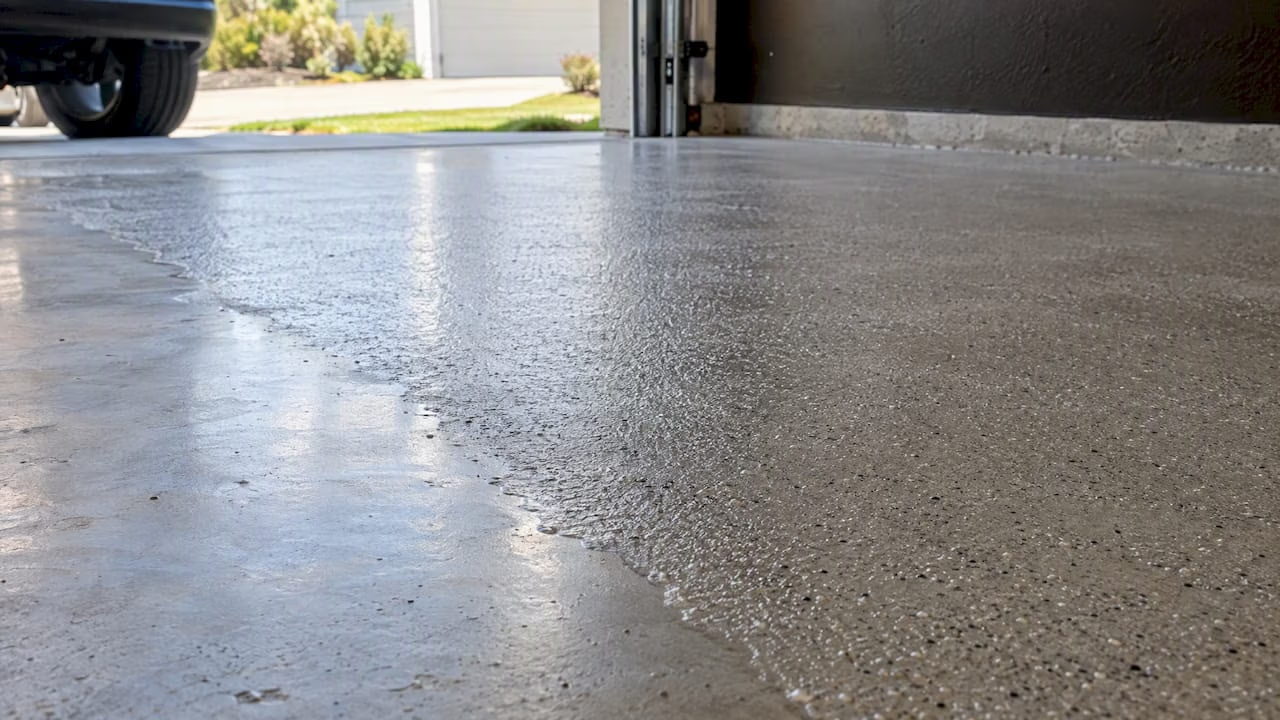
If the floor will be wet often, a different system may fit better than polishing. A full-flake decorative system gives a naturally textured surface and hides dirt, and a UV-stable polyaspartic topcoat protects it. See decorative flake garage floors for what that looks like.
Two cautions apply whichever route you pick:
- Traction products wear. Heavy traffic, grit tracked in and aggressive cleaning change the surface over time, so recheck the floor rather than assuming the day-one result holds.
- Footwear still matters. For wet, oily or dirty work areas, OSHA names slip-resistant footwear alongside textured surfaces as a control. If anyone in your household works on the floor in a shop-style setting, plan for both.
Preparation and moisture decide whether any finish works
A polished or coated floor can only perform as tested if the concrete underneath is sound. Cracks, pitting and moisture coming up through the slab all undermine both the look and the traction. Mechanical diamond grinding opens the surface, crack repair removes trip and peel points, and moisture testing tells you whether anything sealed on top will hold. Read our contractor checklist on moisture mitigation for concrete before you sign anything, and look at how concrete crack repair fits into the plan.
If a contractor offers to polish or coat without mentioning any of this, treat it as a warning sign.
Cleaning and maintenance that preserve traction
A clean floor grips better than a dirty one. A published polished concrete finishing specification gives clear direction:
- Protect the floor from spills and stains during construction.
- Avoid moisture and standing water for 72 hours after the finishing work.
- Stay away from acidic, citrus or butyl cleaners.
- Follow a recommended cleaning schedule, which helps preserve the gloss and reduces absorption of spilled liquids.
For a home garage, that translates into a few habits:
- Sweep or dust-mop regularly. Grit acts like sandpaper on a sealer.
- Wipe oil, coolant and soap film promptly, since they cut traction faster than plain water.
- Use a pH-neutral cleaner recommended for your sealer, and skip vinegar-based or citrus products.
- Put a mat or runner where people step in from outside or out of a wet vehicle.
- Re-test by feel: if the floor seems slicker than it did a year ago, call the installer.
Our perspective: grip is a design decision
We coat garage floors in Conroe and nearby North Houston communities, and the slip question comes up most often after a homeowner sees a glossy showroom floor. Our view is simple. Choose the finish for the way you will actually use the space, then prepare the slab properly. A shiny floor that gets wet every week needs a plan for traction from day one, not a repair after the first scare.
We grind with diamond tooling, repair cracks and pitting, and test for moisture before anything goes down. Then we match the surface to the use: a lower sheen, a flake broadcast or a textured topcoat where water, tires and shoes will be. We back our residential work with a 15-year residential warranty, and an owner-operator oversees the job. If you want a true polished look in a living area, we will tell you plainly where it fits and where a coating serves you better.
— William
What a coating project costs in Conroe
Polished concrete does not have a published price from us, because the quote depends on the slab’s condition and the sheen you want. For coating systems, our published range for garage floor coatings is $4.50 to $7.50 per square foot. Every project starts with a written estimate.
If you want grip, color and easy cleanup in one system, look at our garage floor coating options, which include full-flake, solid-color, metallic and polished finishes, or ask for a quote and tell us how wet the floor gets.
FAQ
Is polished concrete slippery when wet?
It can be, particularly at high gloss and with water, oil or soap film on the surface. CPC testing found that wet slip resistance varied with gloss level. A lower sheen, a traction-enhancing sealer or a textured system can improve grip, and a wet DCOF result for the exact product tells you how it compares.
What wet DCOF number should I look for?
The common reference is 0.42, the ANSI A137.1 requirement for ceramic tile in level interior spaces walked on when wet. NFSI groups level surfaces into below 0.30, 0.30 to 0.44 and 0.45 or higher. Treat the number as a comparison tool, because it does not predict whether a slip will happen.
Does OSHA require a certain friction level for floors?
No. OSHA states it has no standard mandating a particular coefficient of friction for general walking and working surfaces. It cites 0.50 static COF as a nonmandatory guide and says some tasks may call for more. Surface condition and footwear count as well.
How do I clean polished concrete without making it slick?
Sweep regularly, wipe spills quickly and use a cleaner suited to your sealer. Avoid acidic, citrus and butyl cleaners. Check your installer’s care instructions, since the right product depends on the sealer used.
Sources
- Slip Resistance of Polished Concrete, Concrete Polishing Council
- NFSI B101.3-2022: Testing Wet DCOF of Hard Surface Walkways, ANSI
- Static coefficients of friction for walking/working surfaces, OSHA
- Polished Concrete Finishing specification, Section 033543