{
“@graph”: [
{
“@type”: “Article”,
“image”: {
“url”: “https://csuxjmfbwmkxiegfpljm.supabase.co/storage/v1/object/public/blog-images/organization-40763/1786786502355_Close-up-of-garage-floor-with-colored-flakes.jpeg”,
“@type”: “ImageObject”,
“caption”: “Close-up of garage floor with colored flakes”
},
“author”: {
“url”: “https://precision-concretecoating.com”,
“name”: “Precision Concrete Coating in Conroe TX”,
“@type”: “Organization”
},
“headline”: “How Flake Texture Hides Dirt in Garage Floors”,
“publisher”: {
“url”: “https://precision-concretecoating.com”,
“name”: “Precision Concrete Coating in Conroe TX”,
“@type”: “Organization”
},
“inLanguage”: “en-US”,
“description”: “Discover how flake texture effectively hides dirt on garage floors. Learn key choices for a durable, low-maintenance surface that stays clean.”,
“dateModified”: “2026-08-15T09:35:45.713Z”,
“datePublished”: “2026-08-15T09:35:45.713Z”
},
{
“@type”: “BreadcrumbList”,
“itemListElement”: [
{
“item”: “https://precision-concretecoating.com”,
“name”: “Precision Concrete Coating in Conroe TX”,
“@type”: “ListItem”,
“position”: 1
},
{
“item”: “https://precision-concretecoating.com/role-of-flake-texture-in-dirt-hiding”,
“name”: “How Flake Texture Hides Dirt in Garage Floors”,
“@type”: “ListItem”,
“position”: 2
}
]
}
],
“@context”: “https://schema.org”
}

{
“@type”: “FAQPage”,
“@context”: “https://schema.org”,
“mainEntity”: [
{
“name”: “What Are Epoxy Flakes Used For?”,
“@type”: “Question”,
“acceptedAnswer”: {
“text”: “Epoxy flakes add color, pattern, and texture to a coated floor while helping camouflage everyday dust, dirt, and minor scratches between cleanings.”,
“@type”: “Answer”
}
},
{
“name”: “What Are Garage Floor Flakes Made Of?”,
“@type”: “Question”,
“acceptedAnswer”: {
“text”: “Most decorative flakes are vinyl chips, though some are acrylic paint chips, sized roughly a quarter inch to an inch and broadcast into wet epoxy or polyaspartic base coats.”,
“@type”: “Answer”
}
},
{
“name”: “Is There an Epoxy Garage Floor Coating Without Flakes?”,
“@type”: “Question”,
“acceptedAnswer”: {
“text”: “Yes, solid-color epoxy coatings skip flakes entirely for a flat, uniform look, though they show dust and small debris more readily than a flake system.”,
“@type”: “Answer”
}
},
{
“name”: “What Types of Epoxy Flakes Are Available?”,
“@type”: “Question”,
“acceptedAnswer”: {
“text”: “Blends range from single-tone to multi-color mixes in various chip sizes, with mid-tone, multi-color blends generally offering the best dirt camouflage for everyday garage use.”,
“@type”: “Answer”
}
},
{
“name”: “Does Precision Concrete Coating Offer Full Broadcast Systems?”,
“@type”: “Question”,
“acceptedAnswer”: {
“text”: “Yes, Precision Concrete Coating in Conroe TX installs full-flake broadcast systems with polyaspartic topcoats and a 15-year residential warranty, built on mechanically profiled surface prep.”,
“@type”: “Answer”
}
}
]
}
Flake texture hides dirt by creating visual noise: a busy, multi-color surface that camouflages dust, tire grit, and small debris instead of showing every speck against a flat background. It doesn’t make a floor self-cleaning, and it won’t hide fresh oil or standing water. Three choices drive how well it works: blend tone, broadcast density (full versus partial), and topcoat gloss.
- Choose a mid-tone, multi-color blend over pure black or white.
- Ask for full broadcast if the garage sees heavy traffic, pets, or lawn equipment.
- Confirm topcoat type and any anti-slip additive before signing off on a bid.
Key Takeaways
Flake texture hides dirt through visual noise and color matching, not through any self-cleaning property, and full broadcast with a mid-tone blend delivers the strongest everyday camouflage.
| Point | Details |
|---|---|
| Choose mid-tone blends | Multi-color, mid-tone flakes camouflage dust and grit better than pure black or white. |
| Prefer full broadcast for busy garages | Full coverage uses about 100 pounds of flakes per two-car garage and hides imperfections best. |
| Texture and gloss affect visibility | Satin topcoats show less dirt day to day than high-gloss finishes. |
| Cleaning still matters | Sweep weekly, mop monthly, and treat fresh oil immediately regardless of blend. |
| Verify installer specs | Precision Concrete Coating in Conroe TX backs full-flake broadcast and polyaspartic topcoats with a 15-year residential warranty and documented surface prep. |
Table of Contents
- What Are Decorative Flakes and Why Installers Use Them
- The Role of Flake Texture in Dirt Hiding
- Does Texture That Hides Dirt Also Improve Traction?
- Cleaning and Maintenance: What Flakes Hide and What They Don’t
- Installation Choices That Change How Well Flakes Hide Dirt
- Choosing a Flake Blend That Actually Hides Dirt
- Myths and Real Limits of Flake Systems
- Why Surface Prep and Real Specs Matter More Than Blend Choice
- Get a Custom Flake Mockup for Your Garage
- Sources
- FAQ
What Are Decorative Flakes and Why Installers Use Them
Decorative flakes are thin vinyl or paint chips broadcast into a wet epoxy or polyaspartic base coat, where they lock in place as the resin cures. They’re not just décor. A flake layer turns a thin resin film into a multi-layer composite: color and pattern on top, added material thickness in the middle, and a mechanically textured surface that reads differently under light than a smooth painted floor.
Chip sizes typically run from about a quarter inch up to an inch, and blends mix several colors and sizes so no two square feet look identical. The layer sits between the base coat and a clear protective topcoat, which is what locks the chips down and gives the floor its final sheen.
- Made from vinyl (most common) or acrylic paint chips.
- Sized from roughly 1/4 inch to 1 inch, often mixed within a single blend.
- Applied by hand-broadcasting or mechanical spreaders directly into wet coating.
- Sealed under a clear epoxy or polyaspartic topcoat once cured.
The Role of Flake Texture in Dirt Hiding
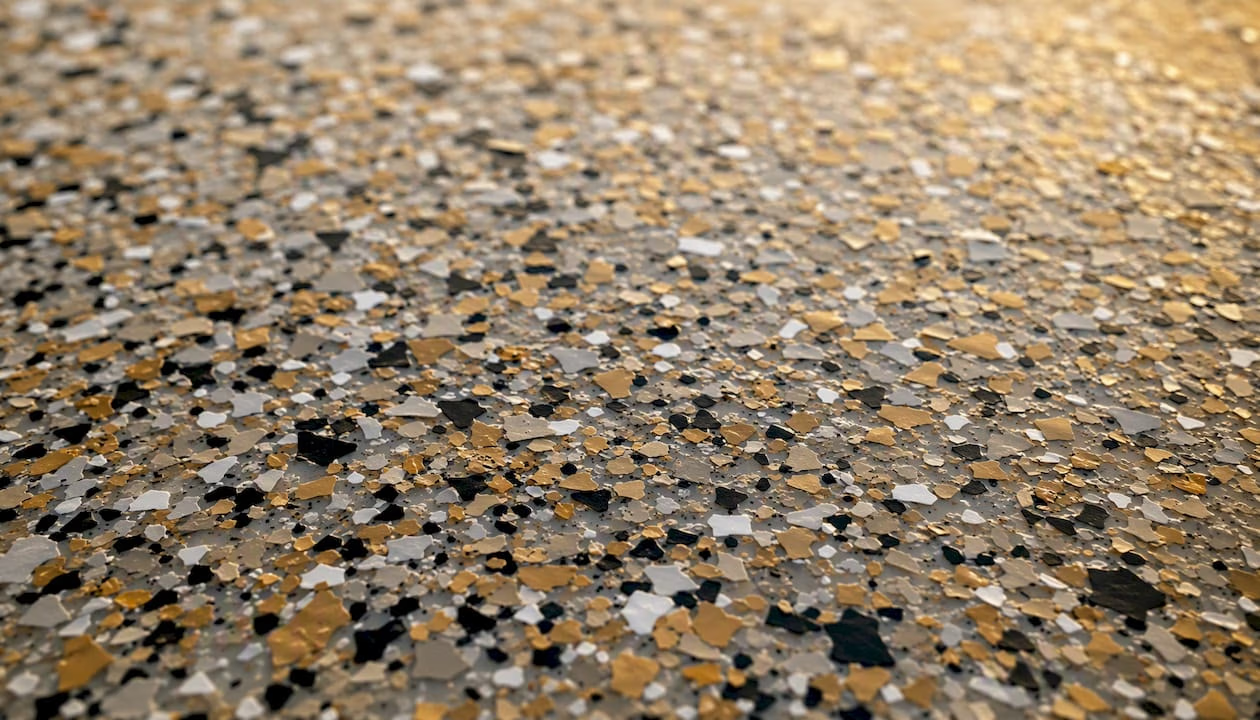
Here’s the visual mechanism at work: a floor with five or six colors scattered across it gives your eye nothing consistent to compare a speck of dust against. On a flat gray or solid-color floor, a crumb of dirt stands out instantly because it breaks a uniform field. Mixing flake sizes and colors produces a complex pattern that swallows small debris rather than framing it, which is exactly why vinyl flake blends are marketed as a dirt-masking feature rather than a purely cosmetic one.
Color theory backs this up in practice. Mid-tones and earthy, rock-like colors (tans, grays, rust, charcoal) sit closer in value to typical garage grime, tire residue, and concrete dust than pure black or pure white does. A blend that already contains those tones absorbs new dirt of a similar shade almost seamlessly.
Density matters just as much as color. When flakes are broadcast to full coverage, or “rejection,” no wet base coat shows through, and the stacked, overlapping chips scatter light unevenly across the surface. That irregular reflection breaks up visual continuity the same way a granite countertop hides fingerprints better than a glass tabletop does.
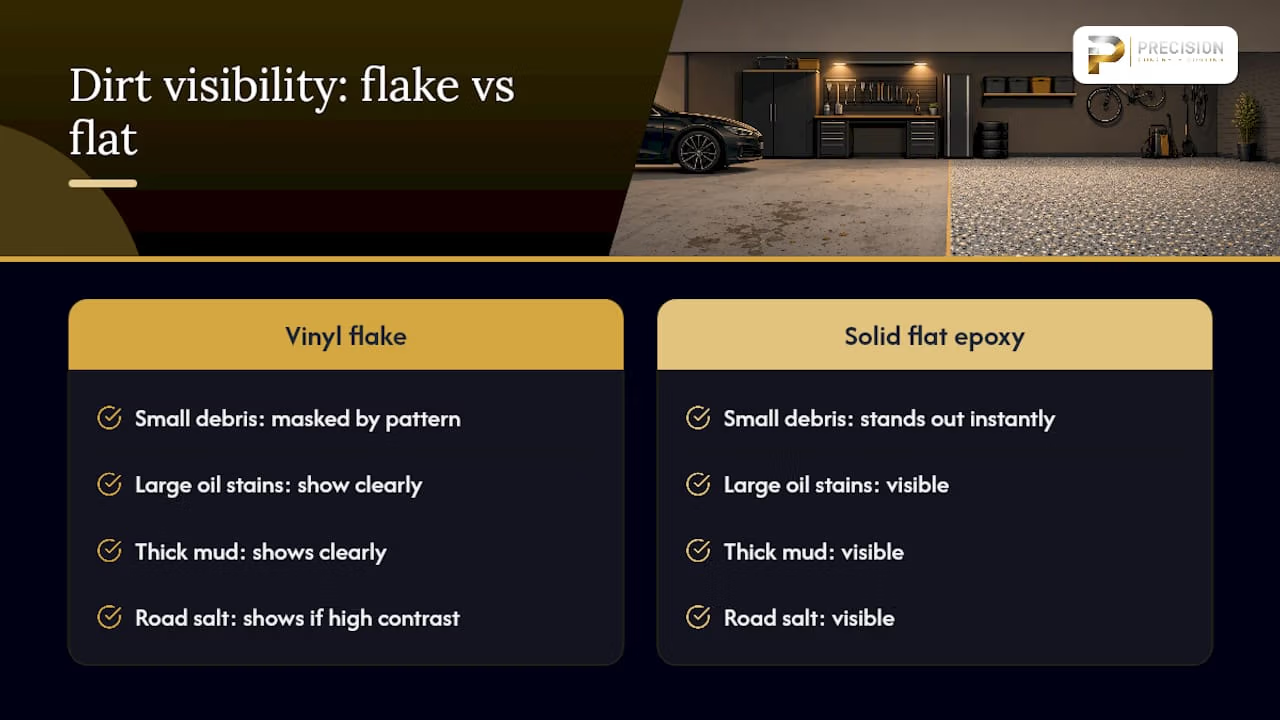
Flakes have real limits, though. Large wet oil stains, thick mud, or road salt residue with strong contrast against the blend will still show clearly, and a blend chosen for looks rather than local dirt tone can work against you.
Pro Tip: Bring a sample of your garage floor’s actual dust (sweep some up) and hold it against blend chips at the showroom. If it disappears into the pattern, that’s your blend.
Does Texture That Hides Dirt Also Improve Traction?
Texture doing double duty is one of the underrated wins of a flake system. A full-broadcast floor has a rougher physical surface than a smooth solid-color coating, and that surface geometry gives feet and tires more to grip, especially with wet shoes or a dripping car.
Topcoats add a second, finer layer of grip. Many installers blend in alumina or polymer grit additives, giving you microscopic traction on top of the macroscopic texture flakes provide. The combination outperforms either one alone.
The best-performing systems pair flake texture for visible camouflage with a light anti-slip additive in the topcoat for grip you can’t see but can feel underfoot.
- Full-broadcast floors outperform smooth, solid-color coatings on wet traction.
- Topcoat additives fill in the gap between visible texture and true slip resistance.
- More texture can mean slightly more effort sweeping into grooves, a fair trade for safety.
Cleaning and Maintenance: What Flakes Hide and What They Don’t
A flake floor still needs regular upkeep. It just needs less panicked upkeep, since the pattern buys you time between cleanings that a solid-color floor wouldn’t.
- Sweep or blow off loose dust and small debris weekly in high-traffic garages, every two to three weeks otherwise.
- Damp mop monthly to lift fine grit the broom leaves behind, especially near door thresholds.
- Blot fresh oil immediately with an absorbent pad. Flakes hide it briefly, but oil that sits will darken the resin underneath.
- Treat stubborn grease or tire marks with a citrus-based degreaser rather than harsh solvents that can dull the topcoat.
- Ask before pressure-washing. Many maintenance plans restrict PSI levels to protect warranty coverage.
Light dust, small pebbles, and dried salt residue are exactly what flakes are good at hiding. Fresh oil, standing water, and thick mud are not. A glossy topcoat shows both dirt and shine faster than a satin finish, so gloss level is worth weighing against how often you’re willing to clean.
Installation Choices That Change How Well Flakes Hide Dirt
Broadcast method is the single biggest lever. Full broadcast covers 90 to 100% of the surface, while partial broadcast intentionally leaves 10 to 50% of the base coat visible for a lighter, speckled look. Full coverage hides imperfections, patch repairs, and everyday debris far better, and it typically calls for about 100 pounds of flakes for a standard two-car garage.
Density within that broadcast matters too. Saturating the coat until no wet resin shows creates the dense, layered pattern that does the actual dirt-hiding work.
- Full broadcast: best camouflage, best durability, higher material cost.
- Partial broadcast: lighter aesthetic, more base coat visible, lower cost.
- Topcoat chemistry (epoxy versus polyaspartic) affects both gloss and how fast it cures.
- Surface preparation, including mechanical profiling and crack repair, has to happen before any flake goes down.
When you’re comparing bids, ask installers these questions:
- What broadcast weight per two-car garage do you use for full coverage?
- Is surface prep done by mechanical diamond grinding, or a lighter method?
- What topcoat do you apply, and at what gloss level?
- What warranty length and scope come with the installation?
Choosing a Flake Blend That Actually Hides Dirt
Mid-tone, multi-color blends consistently outperform single-tone or high-contrast options for everyday camouflage, according to installer guidance on garage floor flake selection. A blend with grays, tans, and a hint of darker accent color mimics the tonal range of typical driveway dust and tracked-in dirt.
A practical cheat code: match your blend to the color of the soil and road grit in your area. Reddish clay soil, sandy tan dirt, and gray urban grime all call for slightly different blend families, and getting close to that native tone does more work than any cleaning routine.
- Favor mid-tones with three to five colors over two-tone or monochrome blends.
- Avoid pure black or pure white if dirt concealment is a priority. Both show contrast fast.
- Request a two-by-two-foot mockup in your actual garage, under your actual lighting, with a car parked nearby.
- Compare the mockup at different times of day. Garage lighting shifts dramatically from morning to evening.
Professional installers report that homeowners often gravitate toward striking black-and-white blends for the showroom look, only to find dust shows up within days. A regional style guide can help you preview options suited to your climate before committing.
Myths and Real Limits of Flake Systems
Flakes get credit for more than they can deliver, so a quick reality check helps.
- Myth: Flakes make a floor self-cleaning. Reality: They reduce how prominent small debris looks; they don’t remove the need to sweep.
- Myth: Textured floors feel rough underfoot. Reality: Finished systems are sanded and sealed smooth while keeping visual texture intact.
- Limit: Active oil leaks, standing water, and heavy industrial traffic will overwhelm any blend’s camouflage effect.
Why Surface Prep and Real Specs Matter More Than Blend Choice
The best-looking flake blend fails early if the concrete underneath wasn’t prepared correctly. Ask any installer for these details in writing before signing anything.
- Mechanical diamond profiling of the slab, not just an acid wash or light grind.
- Moisture testing, plus documented crack and pitting repair before coating.
- Broadcast method and pounds of flake per two-car garage for full coverage.
- Topcoat chemistry (polyaspartic tends to cure faster and resist UV yellowing better than standard epoxy) and gloss level.
- Warranty length. A 10 to 15 year warranty signals confidence in both prep and materials.
Full broadcast systems, applied over a properly profiled slab, create a terrazzo-like finish that resists wear better than solid-color epoxy while giving you the forgiveness of hiding daily dust. Local project photos are worth reviewing before you commit to a blend or a contractor.
An installer’s take on the most common mistake
The floors that age worst almost always started with a homeowner picking a striking, high-contrast blend for the showroom sample rather than their own garage. Combine that with partial broadcast on a garage that sees daily foot traffic, tools, and a dog, and dirt shows up within a week. When you’re unsure, a mid-tone, full-broadcast system is the safer default for any garage that gets real use.
Get a Custom Flake Mockup for Your Garage
A blend that looks great on a sample board can still look wrong under your garage’s actual light, with your actual dirt. Precision Concrete Coating in Conroe TX solves that by starting with real mechanical surface profiling, then matching broadcast density and topcoat gloss to how you actually use your garage, backed by a 15-year residential warranty most competitors don’t offer.

We handle full-flake broadcast, crack and moisture repair, and UV-stable polyaspartic topcoats as one system rather than a checklist of add-ons, and our Granger Pines case study shows how that plays out on a real Conroe-area project. If you’re weighing blends right now, request a two-by-two-foot mockup and a site inspection so you can see how a mid-tone blend handles your garage’s lighting and existing wear before committing to anything.
Sources
- Full Flake Coverage Vs Partial Broadcast And What Hides Dirt Better » Top Gun Garage
- Choosing Garage Floor Flakes: A Decorative Chip Guide
- Partial Flake vs. Full Flake Epoxy: What’s the Difference? | Spraypave Solutions
- Flake & Chip Broadcast Coatings | CoatedLocal
This list is a starting point, not the full technical picture.
FAQ
What Are Epoxy Flakes Used For?
Epoxy flakes add color, pattern, and texture to a coated floor while helping camouflage everyday dust, dirt, and minor scratches between cleanings.
What Are Garage Floor Flakes Made Of?
Most decorative flakes are vinyl chips, though some are acrylic paint chips, sized roughly a quarter inch to an inch and broadcast into wet epoxy or polyaspartic base coats.
Is There an Epoxy Garage Floor Coating Without Flakes?
Yes, solid-color epoxy coatings skip flakes entirely for a flat, uniform look, though they show dust and small debris more readily than a flake system.
What Types of Epoxy Flakes Are Available?
Blends range from single-tone to multi-color mixes in various chip sizes, with mid-tone, multi-color blends generally offering the best dirt camouflage for everyday garage use.
Does Precision Concrete Coating Offer Full Broadcast Systems?
Yes, Precision Concrete Coating in Conroe TX installs full-flake broadcast systems with polyaspartic topcoats and a 15-year residential warranty, built on mechanically profiled surface prep.