
A garage floor that looks wet on a humid day is, more often than not, condensation and not a foundation leak. The fix is to work out where the moisture comes from, bring the humidity and the slab temperature closer together, and only then think about sealing or coating the concrete. A coating on its own will not stop a floor from sweating, and the wrong coating on a wet slab can peel.
We coat garage floors in Conroe and the North Houston area, so we see this every summer. Below is how we would diagnose it, what actually works, what only looks like it works, and how to know when the slab is ready for a coating.
TL;DR
- Most sweating is condensation: warm, humid air meets a cooler slab and drops below its dew point. It looks like a leak but behaves differently.
- Check outside first (grading, gutters, downspouts), then control the air inside with a dehumidifier or air conditioning, and stop pulling humid air in through open doors.
- A plastic-sheet test tells you something, but only a snapshot. In-slab humidity testing (ASTM F2170) is what decides whether a coating can go down.
- Coatings, sealers and mats do not cure condensation. Fix the moisture source first, then prepare and coat the slab properly.
- If you want a coating in the Conroe area, we test moisture before we grind and coat, and our residential work carries a 15-year warranty.
Table of Contents
- Why a garage floor sweats
- Sweating or leaking? How to tell
- Fix the source first
- What doesn’t fix it (and what only helps a little)
- Is the slab ready for a coating?
- Our perspective: prep decides how long a floor lasts
- Choosing a coating once the moisture is under control
- Want a coating on a floor that sweats?
- FAQ
- Sources
Why a garage floor sweats
Concrete holds temperature longer than air does. When humid air moves over a slab that is cooler than the air’s dew point, water condenses on the surface. It is the same thing that happens on a cold soda can on a hot day.
This is why the problem shows up when the weather changes quickly, or when warm, wet air is let into a cooler space. University of Minnesota Extension notes that homeowners often mistake summer condensation for foundation leakage, because humid outdoor air brought into a cooler space condenses on the cold floor. Its advice is to avoid ventilating with warm, humid air in summer and to use mechanical moisture control such as air conditioning or a dehumidifier instead.
Southeast Texas makes this easy to trigger. Climate summaries for Conroe describe humid-feeling air from May through September, with annual rainfall around 51 inches. Open the garage door on a muggy morning when the slab is still cool from an air-conditioned house next door, and the floor can go slick within minutes.
Three things that make a slab colder than the air
- Shade and a cool house. An attached garage shares walls with conditioned space, and the slab can stay cooler than the outdoor air for hours.
- An uninsulated slab edge. Building America Solution Center guidance explains that when the slab edge is not insulated, the perimeter stays cooler than the room air and becomes a cold spot where condensation collects. Rigid foam insulation carried to the top of the slab is the standard way to break that thermal bridge.
- Humid air with nowhere to go. A closed garage with wet items, a clothes dryer venting inside, or a wet car parked after a storm raises the humidity that the cool slab then turns into droplets.
Sweating or leaking? How to tell
The repair is completely different depending on the answer, so check before you buy anything.
| Clue | Points to condensation | Points to a leak or ground moisture |
|---|---|---|
| When it happens | Humid days, after a weather change, in warm months | After rain, or persistently regardless of weather |
| Where it appears | Broadly across the floor, often worst near the door and edges | Along cracks, joints, the wall-floor line, or one low corner |
| What it does | Evaporates as the air dries or the slab warms | Returns in the same spots, may leave stains or white mineral deposits |
| Metal and tools | Cold metal also beads up | Only the floor is affected |
Two simple checks help. First, run your hand over cold items in the garage, such as a toolbox or a paint can. If they bead with water too, the air is the issue. Second, tape a square of clear plastic to the slab, seal all the edges, and look 24 hours later. Water on the underside of the plastic suggests moisture coming up from the slab. Water on top suggests condensation from the air. Our guide to simple moisture tests before recoating walks through the steps.
Be careful about how much you trust that plastic test. A concrete moisture-testing presentation from the Iowa State transportation institute lists condensation (dew point) alongside irrigation and broken pipes as moisture sources that can mislead a test, and surface tests capture only a moment in time. For a decision about a permanent coating, you want a measurement inside the slab.
Fix the source first
The EPA is blunt about the order of operations: controlling moisture is the way to manage mold indoors, and cleaning without fixing the water source does not last. The same logic applies to a wet garage floor. Work from the outside in.
1. Check the outside
Walk the perimeter after a rain. UMN Extension’s moisture-control guidance says to identify and remove the source first, and only then rely on ventilation or a dehumidifier. In practice that means:
- Soil and landscaping should slope away from the garage, not toward it.
- Gutters should be clear, and downspouts should discharge several feet from the slab.
- Flower beds, mulch or sprinkler heads should not soak the ground along the garage wall.
If the floor stays damp for days after rain, or wets along one wall, you are likely dealing with ground moisture or drainage, not just humid air.
2. Stop feeding the garage humid air
In a Houston-area summer, throwing the door open at midday to “air it out” often makes the floor wetter. Open it when the air is drier, or keep it closed on the muggiest days. Do not vent a clothes dryer into the garage, and let wet cars and gear dry elsewhere when you can.
3. Control the humidity inside
The EPA says indoor relative humidity should ideally stay between 30% and 50%, and that 60% is the point where mold and condensation problems increase. A humidity gauge costs under $50 according to the same source, and it removes the guesswork. Put one in the garage for a week and note the readings in the morning and afternoon.
If you want a stable garage floor, the realistic options are:
- A dehumidifier sized for the space, with a drain hose so it does not need emptying constantly. Garage-rated units that tolerate heat are worth the extra cost.
- Air conditioning or a conditioned connection to the house, which lowers both temperature swings and humidity. This is a bigger project, but it is what the UMN guidance points to for summer.
- Insulating the slab edge and sealing gaps where the garage meets the outdoors, so the perimeter stops acting as a cold spot.
4. Deal with real moisture coming up through the slab
If the plastic test or an in-slab probe shows moisture rising from below, humidity control alone will not fix it. Slabs without an intact vapor retarder, or with one that was punctured during construction, can wick moisture for years. Here the answer is moisture mitigation: grinding the surface, then applying a moisture-tolerant primer system, which is the work our moisture mitigation checklist covers.
What doesn’t fix it (and what only helps a little)
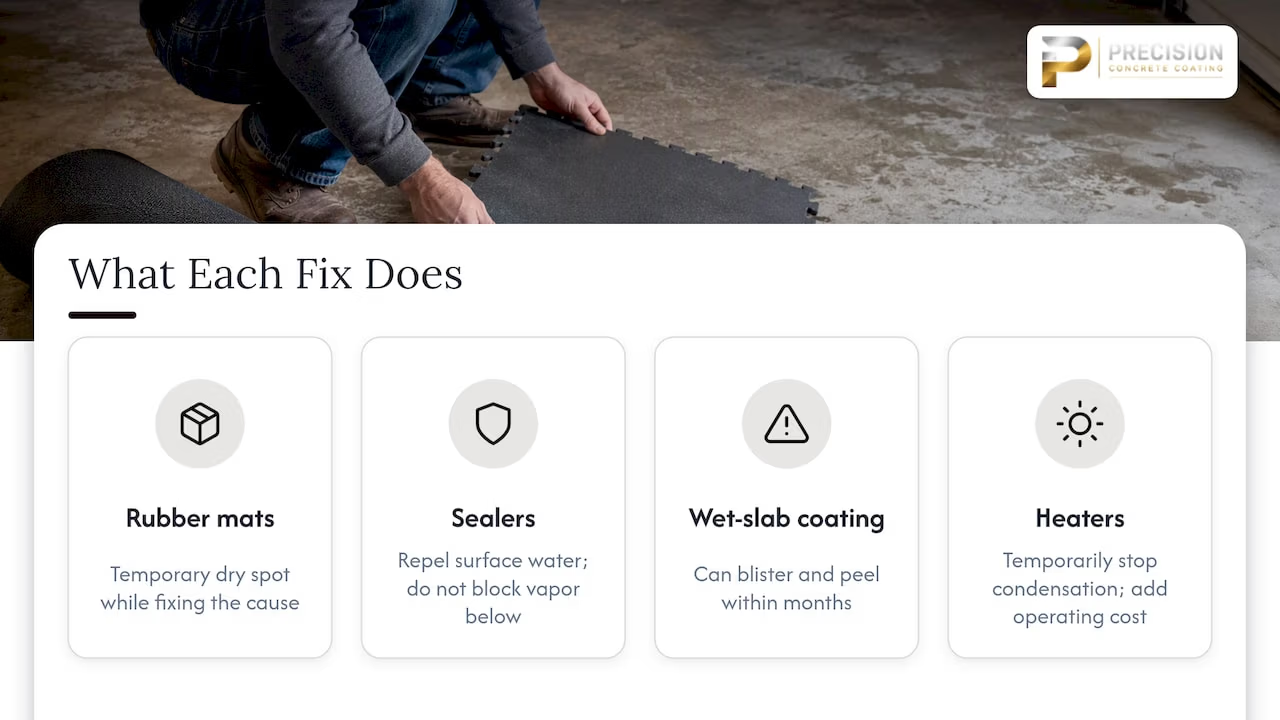
Rubber mats. They will not stop the sweating, but they give you something dry to stand on while the cause is being fixed. Think of them as a temporary patch.
Penetrating sealers. A silane or siloxane sealer repels liquid water from the top and can help against rain-driven moisture. It does not lower the humidity in the air or warm the slab, so condensation can still form. A sealer is not a vapor barrier for water coming up from below, either.
Any coating over a wet slab. This is the costly mistake. Sherwin-Williams’ floor evaluation guidelines describe flooring problems from vapor emission and dew point as costing millions in repair and replacement each year. An impermeable coating trapped over a high-moisture slab can blister and peel within months, because vapor pressure pushes against the bond.
Heaters left running. Warming the floor can stop condensation temporarily, but it does nothing for humidity or ground moisture, and it adds an operating cost.
Is the slab ready for a coating?
A coating can make a garage cleaner, easier to wipe up and better looking. It cannot make a damp slab dry. So test before you commit.
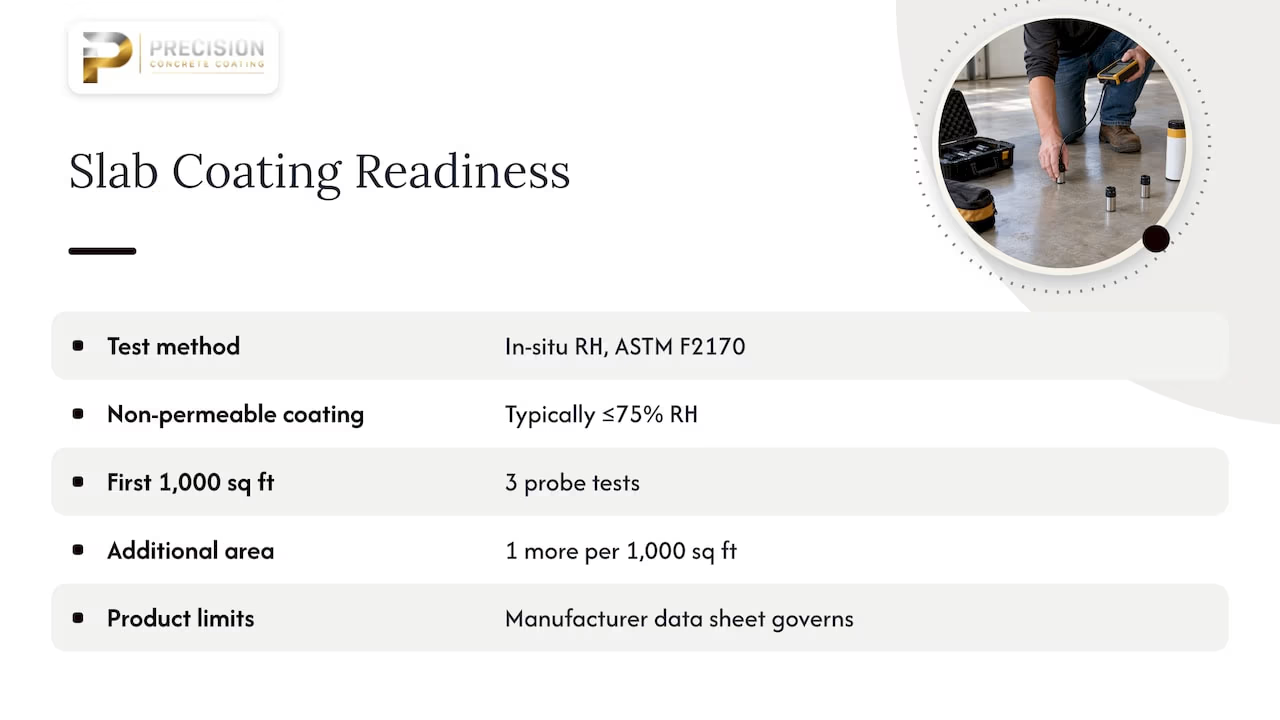
The accepted method is in-situ relative humidity testing under ASTM F2170, where probes are set into holes drilled in the slab. As described in the Sherwin-Williams guidelines, acceptable readings for non-permeable coating systems are typically 75% RH or lower, with three tests in the first 1,000 square feet and one more for each additional 1,000 square feet. The American Concrete Institute’s guide to moisture-sensitive flooring on slabs is the industry reference on the subject. Individual coating manufacturers may set their own limits, so a product’s data sheet governs the job.
The reason to insist on this is timing. Condensation depends on the day. A probe reading depends on the slab. If a contractor tells you the floor is fine because it looked dry on a Tuesday, ask what they measured. We cover what to ask for in our page on requiring ASTM F2170 before coating a garage threshold.
Then comes preparation
If the slab passes, the bond depends on surface prep. Mechanical diamond grinding opens the pores of the concrete so the coating can grip, removes laitance and old sealers, and gives a consistent profile. Cracks and pits get repaired before anything goes down, and crack repair matters here because cracks are also where ground moisture and water tend to show up first.
The same principle holds outside the garage. A masonry contractor in New Jersey makes the same point about patios and walkways in a guide on contractor prep that helps paver sealers last: the sealer is only as good as the surface work and drainage behind it.
Our perspective: prep decides how long a floor lasts
We have a simple rule at Precision Concrete Coating: we do not coat what we have not tested. A sweating slab is a good example of why. The owner calls and says the floor is wet, and the first question is not “which color do you want?” It is “is this the air or the ground?”
If it is the air, a dehumidifier, better door habits and slab edge work solve most of it, and a coating can go on afterwards without trouble. If it is the ground, we say so, test the slab, and plan the moisture mitigation into the job instead of hoping the topcoat holds. That costs more up front than skipping it. It also costs far less than ripping out a blistered floor.
Our process is built around that: mechanical diamond grinding, crack and pit repair, moisture testing, then the coating system. We are owner-operated, so the person who tells you the slab is ready is the person who oversees the work. That is the reason we can stand behind a 15-year residential warranty.
— William
Choosing a coating once the moisture is under control
Once the humidity and the slab check out, the system you choose is about how you use the garage.
- Full-flake decorative epoxy. Flakes hide dirt, tire marks and minor surface variation, which is why they are popular in busy family garages. See our decorative flake garage floors.
- Polyaspartic topcoat. A UV-stable protective layer that resists yellowing in a garage with bright doors or windows. More on polyaspartic coatings.
- Solid color or metallic epoxy. Cleaner, more uniform looks, with the same need for dry, well-prepared concrete.
If your garage is attached and you open the door often, airflow and prep matter even more, which we explain in epoxy in an attached garage.
What it costs
Our published range for garage floor coatings is $4.50 to $7.50 per sq ft, installed. Where you land depends on the slab condition, repairs, the system and any moisture work. A written estimate shows the number for your floor, and the cost and estimate page explains what goes into it.
Want a coating on a floor that sweats?
If you are in Conroe or the surrounding North Houston area and your garage floor gets wet, we will look at the slab before we quote a coating. We test moisture, grind, repair cracks and pitting, then install the system you choose. See our garage floor coatings or contact us from our home page to request a written estimate.
FAQ
Why does my garage floor get wet when it rains, or on humid days?
If it is wet on a humid day with no rain, it is most likely condensation from warm, humid air hitting a cooler slab. If it is wet after rain and in the same spots each time, look at grading, gutters, downspouts and cracks. The two can overlap, so check the outside first.
Is a sweating garage floor harmful?
The water itself is mostly a slip hazard and a nuisance for stored items. The bigger concern is repeated dampness, which the EPA links to mold growth when humidity stays high. Keep the floor dry, keep cardboard and fabric off it, and see a qualified professional if you find mold or musty smells you cannot trace.
Will sealing or coating the floor stop the sweating?
No. Sealers and coatings change the surface, not the air humidity or the slab temperature, so condensation can still form on top. A coating is a good finish once the moisture source is under control, and it can make the floor easier to wipe dry.
Do I need a dehumidifier in my garage?
In a humid climate like southeast Texas, often yes if the garage stays above the EPA’s 60% relative humidity limit. Put a gauge in for a week to find out. A dehumidifier with a drain hose, plus keeping the door closed on muggy days, solves many cases.
How do I know if my slab is dry enough for epoxy or polyaspartic?
Have it tested with in-slab relative humidity probes under ASTM F2170. Readings at or below roughly 75% are typical for non-permeable coatings, though the product’s own data sheet decides. A plastic-sheet test is a useful first look but not enough on its own.
Sources
- What are the ten things I need to know about mold? (US EPA)
- Moisture in basements: causes and solutions (UMN Extension)
- Controlling moisture problems in your home (UMN Extension)
- Slab edge insulation (Building America Solution Center)
- Concrete Moisture and pH Testing (Iowa State, InTrans)
- Floor Evaluation Guidelines (Sherwin-Williams)
- ACI PRC-302.2-22 guide (American Concrete Institute)
- Conroe, Texas average monthly weather
2 Responses