{
“@graph”: [
{
“@type”: “Article”,
“image”: {
“url”: “https://csuxjmfbwmkxiegfpljm.supabase.co/storage/v1/object/public/blog-images/organization-40763/1787348152966_Applying-polyaspartic-coating-in-garage.jpeg”,
“@type”: “ImageObject”,
“caption”: “Applying polyaspartic coating in garage”
},
“author”: {
“url”: “https://precision-concretecoating.com”,
“name”: “Precision Concrete Coating in Conroe TX”,
“@type”: “Organization”
},
“headline”: “What Makes Floors Resistant to Grease and Oil Stains”,
“publisher”: {
“url”: “https://precision-concretecoating.com”,
“name”: “Precision Concrete Coating in Conroe TX”,
“@type”: “Organization”
},
“inLanguage”: “en-US”,
“description”: “Discover the key factors that make floors resistant to grease and oil stains, ensuring long-lasting beauty and safety in your space.”,
“dateModified”: “2026-08-21T21:36:05.743Z”,
“datePublished”: “2026-08-21T21:36:05.743Z”
},
{
“@type”: “BreadcrumbList”,
“itemListElement”: [
{
“item”: “https://precision-concretecoating.com”,
“name”: “Precision Concrete Coating in Conroe TX”,
“@type”: “ListItem”,
“position”: 1
},
{
“item”: “https://precision-concretecoating.com/what-makes-floors-resistant-to-grease”,
“name”: “What Makes Floors Resistant to Grease and Oil Stains”,
“@type”: “ListItem”,
“position”: 2
}
]
}
],
“@context”: “https://schema.org”
}

{
“@type”: “FAQPage”,
“@context”: “https://schema.org”,
“mainEntity”: [
{
“name”: “Why is my floor so slippery all of a sudden?”,
“@type”: “Question”,
“acceptedAnswer”: {
“text”: “A sudden change in traction usually means grease or oil residue has built up on top of the finish rather than being absorbed, often from cooking, cleaning products, or tracked-in automotive fluid. A textured or aggregate-broadcast coating resists this better than a smooth, high-gloss finish.”,
“@type”: “Answer”
}
},
{
“name”: “What cuts grease on floors?”,
“@type”: “Question”,
“acceptedAnswer”: {
“text”: “Alkaline degreasers break down grease through saponification and work well on fresh to moderate stains, while enzymatic cleaners are better suited to older, set-in organic residue. For grease that has soaked into concrete, a poultice pulls it out through extraction rather than surface cleaning.”,
“@type”: “Answer”
}
},
{
“name”: “Does Murphy’s Oil Soap make floors slippery?”,
“@type”: “Question”,
“acceptedAnswer”: {
“text”: “Oil-based soaps can leave a residue on hard flooring if not rinsed thoroughly, which builds up over repeated uses and can make finished floors feel slick underfoot. It’s better suited to wood floors than sealed concrete or coated surfaces, and always needs a clean water rinse afterward.”,
“@type”: “Answer”
}
},
{
“name”: “What is the best oil to use on wood floors?”,
“@type”: “Question”,
“acceptedAnswer”: {
“text”: “Tung oil and linseed oil are common choices for unfinished wood because they penetrate the fibers rather than sitting on top, but neither creates the kind of continuous barrier that resists grease the way a polyurethane film finish does. For kitchens or high-traffic wood floors, a multi-coat polyurethane offers far better grease resistance.”,
“@type”: “Answer”
}
},
{
“name”: “Is epoxy or polyaspartic better for grease resistance?”,
“@type”: “Question”,
“acceptedAnswer”: {
“text”: “Both create a non-porous surface that blocks grease penetration, but polyaspartic generally offers better resistance to heat and UV exposure and cures faster, which is why installers like Precision Concrete Coating in Conroe TX often specify it as the topcoat over epoxy base layers in garages.”,
“@type”: “Answer”
}
}
]
}
The most important factors that make a floor resistant to grease are a seamless, non-porous surface, correct surface preparation before any coating goes down, and a finish suited to the room’s traffic and mess. Get those three right and grease sits on top of the floor instead of soaking into it.
Concrete, wood, and even some tile are porous at a microscopic level. Oil finds those openings through capillary action and works its way in, which is why a mop and dish soap can’t lift a stain that’s already a week old. Stopping that migration comes down to three things:
- A continuous barrier or filled pores. Epoxy and polyaspartic coatings form an unbroken film; silane-siloxane sealers plug the capillaries themselves.
- A clean, mechanically prepared substrate. Coatings bond to an open concrete profile, not a slick or contaminated one.
- The right surface texture. Aggregate or flake broadcasts keep a greasy floor from becoming a slip hazard.
Pro Tip: A floor that looks fine after a spill isn’t automatically grease-resistant. The real test is what happens after 48 hours, once oil has had time to migrate if the surface isn’t actually sealed.
Key Takeaways
Grease resistance comes from a seamless coating or penetrating sealer paired with proper mechanical surface preparation, not from the topcoat product alone.
| Point | Details |
|---|---|
| Prep decides longevity | Diamond grinding removes contaminated concrete and creates the profile coatings need to bond permanently. |
| Coatings vs. sealers | Epoxy and polyaspartic form a surface film; silane-siloxane sealers fill pores without changing the floor’s look. |
| Clean fresh spills fast | Blot with an absorbent material immediately, then use alkaline degreasers or enzymatic cleaners depending on stain age. |
| Set-in stains need extraction | A poultice pulls embedded oil out through osmosis; pressure washing bare concrete can push it deeper. |
| Precision Concrete Coating’s approach | The Conroe TX installer grinds first, repairs cracks, and finishes with a polyaspartic topcoat backed by a 15-year residential warranty. |
Table of Contents
- How Coatings and Sealers Actually Block Grease
- Grease-Resistant Flooring Materials by Room and Use
- Why Surface Preparation Controls Long-Term Grease Resistance
- How to Clean Grease Stains, Fresh and Set-In
- Slip Resistance Without Sacrificing Grease Protection
- How to Choose the Right Treatment for Your Floor
- Lifespan, Maintenance, and What Drives Cost
- Why a Systems Approach Prevents Grease Problems Long-Term
- What Actually Matters When You’re Choosing a Grease-Resistant Floor
- How Precision Concrete Coating Handles Grease Resistance in Conroe Garages
- Sources
- FAQ
How Coatings and Sealers Actually Block Grease
Untreated concrete behaves like a hard sponge. It’s full of microscopic capillaries left over from the water that evaporated during curing, and those channels pull liquid hydrocarbons inward the same way a paper towel pulls up coffee. Once oil gets past the surface, it’s no longer a cleaning problem. It’s an extraction problem, and those are much harder to solve.
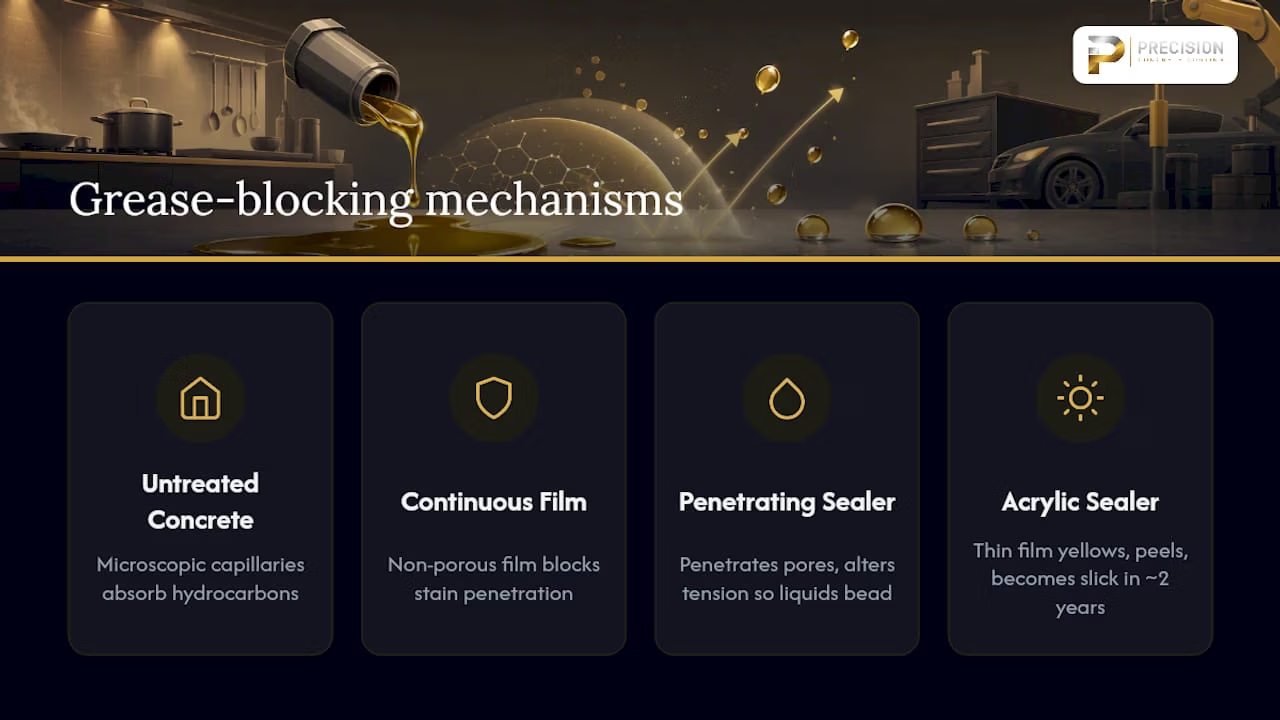
Two-part epoxy and polyaspartic coatings solve this by forming a continuous film across the entire slab. There’s no gap for grease to find, and two-part epoxy coatings create a non-porous surface that resists staining agents that would otherwise sink straight into raw concrete. Polyaspartic topcoats work on the same principle but cure faster and generally hold up better against thermal cycling and repeated chemical contact, which matters if the floor sees hot tire rubber or hot degreaser splashes.
Penetrating sealers take a different approach entirely. Rather than sitting on top of the concrete, silane-siloxane formulas travel into the pores and change the surface tension inside them, so liquids bead up instead of soaking in. Some products reduce water absorption significantly, though they leave the surface looking essentially unchanged, which is why homeowners often assume they haven’t done anything.
Where cheaper acrylic topical sealers fall short is durability. They sit as a thin film that yellows, peels, and gets slick underfoot within a couple of years, especially in a garage exposed to Texas heat and UV. A professional multilayer system, by contrast, is built to be walked on and driven over for years before it needs attention.
Grease-Resistant Flooring Materials by Room and Use
Not every space needs the same solution, and picking the wrong one is how homeowners end up redoing a floor twice.
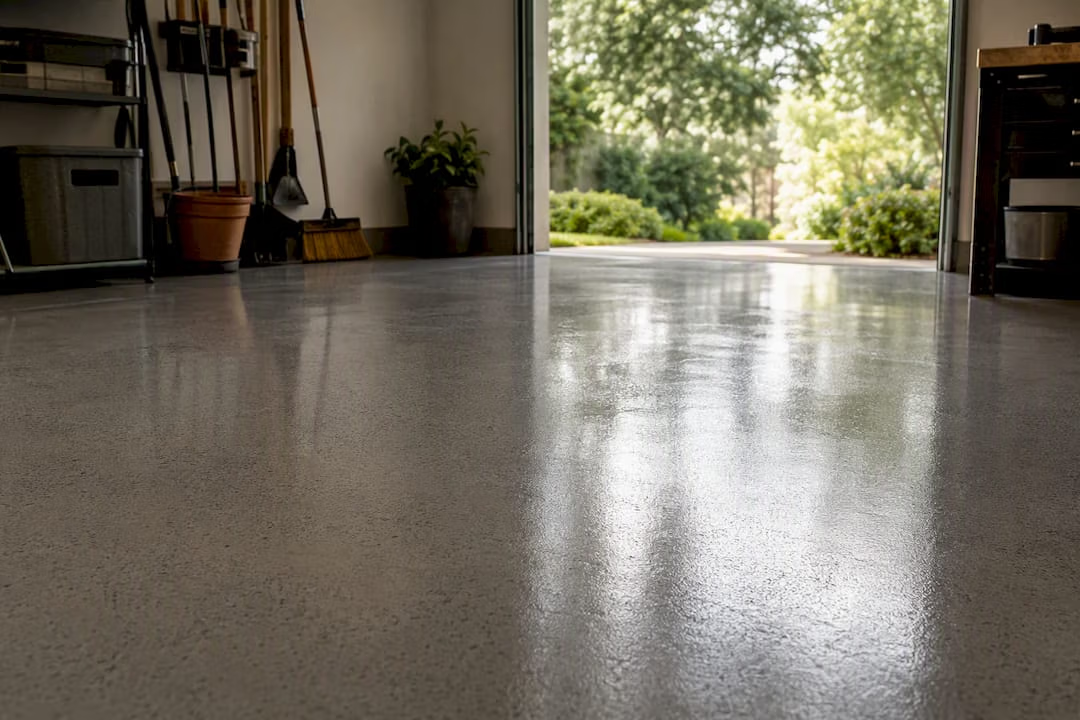
Coated concrete is the standard for garages, workshops, and anywhere motor oil, brake fluid, or grease-caked tools are part of daily life. A properly installed epoxy or polyaspartic system shrugs off automotive fluids that would otherwise stain bare concrete permanently within hours.
Glazed tile resists grease reasonably well on the tile face itself, but the grout lines are the weak point. Unsealed grout is essentially exposed cement, and it absorbs oil just as fast as bare concrete does. Sealing grout annually is non-negotiable in a kitchen that sees regular cooking.

Vinyl and sheet flooring hold up fine under light residential cooking but degrade under sustained heat or solvent exposure, and seams are a failure point where grease can wick underneath.
Wood floors are the trickiest material on this list. A polymerized, film-forming finish (a quality polyurethane, applied in multiple coats) creates a barrier similar in concept to epoxy, but wood expands and contracts with humidity, so the finish eventually cracks at the edges. Oil-based finishes like tung or linseed oil actually soak into the wood rather than sitting on top, which is fine for appearance but does nothing to stop grease penetration.
Polished concrete looks striking and resists moderate wear, but densifiers alone only harden the surface. They don’t create a grease barrier. Kitchens, garages, or commercial floors with real grease exposure still need a topical coating or penetrating sealer layered on top of the polish.
Why Surface Preparation Controls Long-Term Grease Resistance
A coating is only as good as what it’s bonded to. Concrete porosity exists because of how cement hydrates, and that same porosity is what lets a resin coating mechanically interlock with the slab, but only if the surface profile is opened up correctly first.
- Mechanical grinding removes the weak layer. Diamond grinding strips away the top layer of concrete, along with any laitance, old sealer, or contamination, and leaves a rough, open profile the coating can grip.
- Acid etching is the weaker alternative. It roughens the surface chemically but can leave residual contaminants behind, or worse, seal grease-affected concrete under a coating instead of removing it.
- Contaminated slabs need testing, not guessing. Old oil stains, especially in a garage that’s housed vehicles for years, often run deeper than they look. Grinding over epoxy is standard practice precisely because it exposes and removes that contamination rather than trapping it.
- DIY works for light, cosmetic jobs only. A small, lightly used space with no history of oil staining might tolerate an etch-and-coat approach. Anything with real grease exposure calls for professional grinding equipment.
Pro Tip: If a garage floor has ever had a persistent oil stain, assume the contamination goes deeper than the surface. Coating over it without grinding traps the grease between the slab and the coating, and it will eventually show through as a ghost stain.
Skip this step and the consequences show up later: delamination, bubbling, and grease that reappears through the coating months after installation, because it was never actually removed.
How to Clean Grease Stains, Fresh and Set-In
Speed matters more than product choice in the first few minutes after a spill.
- Blot, don’t rub. Use an absorbent material such as cat litter, sawdust, or a commercial absorbent pad to lift as much surface oil as possible before it starts migrating.
- Match the cleaner to the stain’s age. Alkaline degreasers work by saponifying fats, breaking heavy grease down into something water-soluble, while enzymatic cleaners are better suited to older, organic residue that’s already partially set.
- Go deeper for stains that have soaked in. A poultice, an absorbent paste left over the stain for 24 to 48 hours, draws oil out of the concrete’s interior through osmosis rather than surface scrubbing.
- Skip the pressure washer on bare concrete. High-pressure water can drive embedded oil deeper into the slab instead of out of it. It’s genuinely useful only on a sealed, coated surface where grease is sitting on top rather than inside.
- Neutralize and dry before sealing. Any residual alkaline cleaner needs to be rinsed and the surface fully dried before a sealer or coating goes on, or adhesion will suffer.
Following a poultice with a penetrating sealer prevents the stain from wicking back to the surface as the slab finishes drying, which is a common reason “cleaned” concrete develops a faint stain again weeks later.
Slip Resistance Without Sacrificing Grease Protection
A perfectly sealed floor that sends someone sliding across the garage isn’t actually a win. Coefficient of friction, essentially how much grip a surface offers underfoot, drops fast on smooth, glossy coatings once they’re wet with oil.
- Textured finishes solve this at the material level. Broadcasting quartz or aggregate into the coating gives the surface tooth that stays gripping even when greasy.
- Commercial kitchens build this in from the start. Oleophobic coatings with integrated aggregate are specified for exactly this reason: they repel oil and hold traction at the same time.
- Smooth, high-gloss finishes are the wrong pick for high-grease zones, no matter how good they look in photos.
- Mats, prompt cleanup, and clear signage cover the gap in commercial spaces where a coating alone can’t guarantee traction.
How to Choose the Right Treatment for Your Floor
Start with an honest read of what the floor actually deals with. A garage that sees occasional oil drips needs less than a commercial kitchen running deep fryers ten hours a day.
- Define the exposure level first. Heavy chemical or grease traffic needs a full coating system; light residential use might get by with a quality penetrating sealer.
- Ask about mechanical prep specifically. A contractor who can’t describe their grinding process or skips substrate preparation entirely is cutting a corner that shows up in two years, not two months.
- Request adhesion testing, not just a sales pitch. A reputable installer can explain how they verify the coating is actually bonding to the slab.
- Compare total cost over the coating’s life, not just the invoice total. A cheaper coating that fails in three years costs more than a proper system that lasts twelve.
Pro Tip: Walk away from any quote that promises a single coat over unground concrete. That combination is the single most common reason garage coatings fail within the first year.
Red flags worth remembering: vague warranty language, no mention of grinding or profiling, and pricing that seems too good given the square footage involved.
Lifespan, Maintenance, and What Drives Cost
Different systems age differently, and knowing the range helps set realistic expectations.
- Penetrating sealers generally last 1 to 5 years depending on the formula and traffic level, then need reapplication.
- Epoxy coatings typically hold up 3 to 7 years before recoating becomes necessary, longer with light use.
- Polyaspartic systems often run 5 to 15 years depending on the specific system and how well the floor is maintained.
- Daily habits matter as much as the coating itself. Wiping up spills before they sit, and periodically inspecting for delamination or dulling, catches small problems before they become expensive ones.
- Cost is driven mainly by prep intensity and square footage, not the coating material alone. A slab that needs heavy grinding or crack repair costs more regardless of which topcoat goes on afterward.
Why a Systems Approach Prevents Grease Problems Long-Term
Grease resistance isn’t one product. It’s a sequence: grind, repair, prime, broadcast decorative flake, then seal with a polyaspartic topcoat. Skip a step and the whole system is only as strong as its weakest layer.
- A documented prep process and a written warranty are the two clearest signs an installer takes this seriously.
- Aftercare guidance, cleaning schedules, and recoat timing keep grease from finding its way back in years down the line.
What Actually Matters When You’re Choosing a Grease-Resistant Floor
Most advice on this topic obsesses over the coating brand, epoxy versus polyaspartic, this sealer versus that one, while treating surface prep as a footnote. That’s backward. The single biggest predictor of whether a floor stays grease-free for a decade is whether the concrete was properly ground and cleaned before anything touched it. A mediocre coating over perfect prep will outlast a premium coating over a contaminated slab almost every time.
The other place conventional wisdom misses the mark is stain removal. People reach for a pressure washer or scrub harder when a stain doesn’t budge, not realizing that’s often the worst move on unsealed concrete. Oil that’s already migrated into the pores needs extraction, a poultice or the right degreaser, not brute force.
If you’re planning a coating project, prioritize in this order: confirm the contractor grinds rather than etches, confirm the system includes a real topcoat rated for your exposure level, and only then start comparing colors and flake patterns. Get that sequence backward and you’ll be redoing the floor sooner than you think.
How Precision Concrete Coating Handles Grease Resistance in Conroe Garages
Skipping prep is exactly what turns a good-looking coating into a five-year failure, and it’s the corner most cheaper jobs cut. Precision Concrete Coating in Conroe TX builds every project around mechanical diamond grinding first, then crack repair, a decorative flake broadcast, and a UV-stable polyaspartic topcoat rated to stand up to Texas heat, automotive fluids, and years of daily traffic.

That prep-first sequence is backed by a 15-year residential warranty, which is longer than most quick-turnaround coating jobs offer because the process is designed to prevent the delamination and grease wicking that shorten a floor’s life. If your garage has stubborn stains or an aging slab, the Granger Pines case study shows how that process plays out on a real project.
DIY sealing can work for a lightly used space with no history of oil stains. A garage with years of automotive use, cracking, or embedded grease is a job for mechanical grinding equipment a homeowner typically doesn’t own. If that’s your situation, request a written estimate and find out what a properly prepped, warrantied floor actually costs for your space.
Sources
- Removing Stains from Concrete: Methods, Products, and Prevention
- Rapidrepair
- How To Remove Cooking Oil From Concrete Surfaces – Restaurant Technologies
- Pro Commercial Kitchen Floor Coating | Kitchen Floor Solutions
FAQ
Why is my floor so slippery all of a sudden?
A sudden change in traction usually means grease or oil residue has built up on top of the finish rather than being absorbed, often from cooking, cleaning products, or tracked-in automotive fluid. A textured or aggregate-broadcast coating resists this better than a smooth, high-gloss finish.
What cuts grease on floors?
Alkaline degreasers break down grease through saponification and work well on fresh to moderate stains, while enzymatic cleaners are better suited to older, set-in organic residue. For grease that has soaked into concrete, a poultice pulls it out through extraction rather than surface cleaning.
Does Murphy’s Oil Soap make floors slippery?
Oil-based soaps can leave a residue on hard flooring if not rinsed thoroughly, which builds up over repeated uses and can make finished floors feel slick underfoot. It’s better suited to wood floors than sealed concrete or coated surfaces, and always needs a clean water rinse afterward.
What is the best oil to use on wood floors?
Tung oil and linseed oil are common choices for unfinished wood because they penetrate the fibers rather than sitting on top, but neither creates the kind of continuous barrier that resists grease the way a polyurethane film finish does. For kitchens or high-traffic wood floors, a multi-coat polyurethane offers far better grease resistance.
Is epoxy or polyaspartic better for grease resistance?
Both create a non-porous surface that blocks grease penetration, but polyaspartic generally offers better resistance to heat and UV exposure and cures faster, which is why installers like Precision Concrete Coating in Conroe TX often specify it as the topcoat over epoxy base layers in garages.
One Response