
{
“@graph”: [
{
“@type”: “Article”,
“image”: {
“url”: “https://csuxjmfbwmkxiegfpljm.supabase.co/storage/v1/object/public/blog-images/organization-40763/1787513938295_Close-up-of-thin-epoxy-coating-lifting-on-garage-floor.jpeg”,
“@type”: “ImageObject”,
“caption”: “Close-up of thin epoxy coating lifting on garage floor”
},
“author”: {
“url”: “https://precision-concretecoating.com”,
“name”: “Precision Concrete Coating in Conroe TX”,
“@type”: “Organization”
},
“headline”: “Why Thin Coatings Fail Quickly (And How to Diagnose It)”,
“publisher”: {
“url”: “https://precision-concretecoating.com”,
“name”: “Precision Concrete Coating in Conroe TX”,
“@type”: “Organization”
},
“inLanguage”: “en-US”,
“description”: “Discover the four key reasons why thin coatings fail quickly and how to properly diagnose issues before it’s too late. Protect your garage floor!”,
“dateModified”: “2026-08-23T19:39:18.743Z”,
“datePublished”: “2026-08-23T19:39:18.743Z”
},
{
“@type”: “BreadcrumbList”,
“itemListElement”: [
{
“item”: “https://precision-concretecoating.com”,
“name”: “Precision Concrete Coating in Conroe TX”,
“@type”: “ListItem”,
“position”: 1
},
{
“item”: “https://precision-concretecoating.com/why-thin-coatings-fail-quickly”,
“name”: “Why Thin Coatings Fail Quickly (And How to Diagnose It)”,
“@type”: “ListItem”,
“position”: 2
}
]
}
],
“@context”: “https://schema.org”
}

{
“@type”: “FAQPage”,
“@context”: “https://schema.org”,
“mainEntity”: [
{
“name”: “How Quickly Can A Thin Coating Fail?”,
“@type”: “Question”,
“acceptedAnswer”: {
“text”: “Thin DIY coatings under 10 mils can start peeling within 1 to 2 years, especially in tire lanes or areas with untested moisture.”,
“@type”: “Answer”
}
},
{
“name”: “Can I Just Patch The Bubbled Or Peeling Area?”,
“@type”: “Question”,
“acceptedAnswer”: {
“text”: “Usually no. Patching over untested moisture or contamination without removing the failed layer typically leads to repeat failure in the same spot.”,
“@type”: “Answer”
}
},
{
“name”: “Is Polyaspartic Better Than Epoxy For Moisture-Prone Slabs?”,
“@type”: “Question”,
“acceptedAnswer”: {
“text”: “Polyaspartic systems tolerate moisture and UV exposure better than many epoxies and resist hot-tire pickup more reliably, making them a common recommendation for sun-exposed or borderline-moisture garages.”,
“@type”: “Answer”
}
},
{
“name”: “How Long Does A Professional Re-Coat Take?”,
“@type”: “Question”,
“acceptedAnswer”: {
“text”: “A typical two-car garage needs 1.5 to 3 days once degreasing, grinding, crack repair, and moisture testing wait times are included.”,
“@type”: “Answer”
}
},
{
“name”: “What Should I Ask A Contractor Before Hiring Them?”,
“@type”: “Question”,
“acceptedAnswer”: {
“text”: “Ask whether they run ASTM F1869 or F2170 moisture testing, grind to a specific CSP target, and put mil thickness in writing. Precision Concrete Coating in Conroe TX includes all three in every written scope.”,
“@type”: “Answer”
}
}
]
}
Thin garage coatings fail fast for four overlapping reasons: moisture pushing up from below, a slab surface that was never properly ground, oil or grease trapped under the film, and film thickness too thin to survive foot and tire traffic. If your floor is bubbling, peeling, or lifting at the edges within a year or two, stop parking heavy vehicles on it and document what you’re seeing.
- Moisture vapor transmission from an untested slab
- Inadequate mechanical preparation (laitance left behind, no real profile)
- Oil, grease, or sealer contamination under the coating
- Insufficient film thickness for the traffic the floor sees
The next move is a real moisture assessment using ASTM F1869 or ASTM F2170 testing, not a guess. Precision Concrete Coating in Conroe TX runs both as standard practice before any coating goes down.
Key Takeaways
Thin coating failure almost always traces to untested moisture, skipped grinding, or a film laid down thinner than the traffic it has to survive.
| Point | Details |
|---|---|
| Moisture is a top cause | About 38% of epoxy failures tie to untested moisture vapor transmission before coating. |
| Grinding beats acid etch | Diamond grinding produces a verifiable CSP; acid etching often can’t match it reliably. |
| Thickness determines lifespan | Thin DIY coatings often fail in 1 to 2 years; properly specified pro jobs commonly last 10 to 15 years. |
| Don’t patch over root causes | Spot repairs over untested moisture or contamination usually fail again. |
| Precision Concrete Coating’s process | Documents moisture testing, grinding to CSP, and mil thickness, backed by a 15-year residential warranty. |
Where To Verify These Standards
- AMPP: concrete moisture testing and mitigation guidance
- 30DayPivot: concrete prep, grinding, and CSP targets
- National Epoxy: the 9 real causes of epoxy floor failure
Table of Contents
- Common Causes Of Thin Coating Failure
- Why Thin Films Can’t Survive What Garage Floors Throw At Them
- What A Professional Does To Prevent It
- What To Do If Your Floor Is Already Failing
- Sources
- FAQ
Common Causes Of Thin Coating Failure
Most garage floor coating failures trace back to one of six root problems, and they rarely show up alone.
- Moisture vapor transmission. Water vapor moves up through concrete constantly, even on slabs that look bone dry. When it hits an impermeable coating, it has nowhere to go and pushes the film off the slab, causing bubbles or blisters. Roughly 38% of epoxy flooring failures tie back to moisture issues that were never tested for before installation.
- Poor mechanical preparation. New and old slabs both develop laitance, a weak, powdery layer of cement paste at the surface. Coating over it is like painting over dust. Acid etching, the DIY go-to, roughens the surface chemically but rarely produces a reliable Concrete Surface Profile (CSP), and manufacturers increasingly discourage it for that reason.
- Contamination. Old oil stains, transmission fluid, and even residue from a previous sealer soak into concrete pores and block adhesion. Surface cleaning alone doesn’t remove it. It needs degreasing followed by grinding to actually pull contaminated material out.
- Insufficient film thickness. Many retail kits and one-day franchise jobs lay down coatings well under professional mil targets. Thin film has less material to resist abrasion, chemicals, and UV, so it wears through at tire paths and near the garage door first.
- Mixing and cure mistakes. Off-ratio mixing, missing a recoat window, or coating when the slab temperature is too close to the dew point all leave soft, tacky, or unevenly cured patches that fail early regardless of how good the prep was.
- Localized substrate issues. Low spots that pond water, control joints that flex, and old sealer residue in isolated areas create failure points long before the rest of the floor shows problems.
Statistic to remember: moisture-related failure isn’t a fringe issue. It’s the second most common cause of coating failure industry-wide, right behind poor preparation, and it’s almost always preventable with proper testing before the coating goes on.
Why Thin Films Can’t Survive What Garage Floors Throw At Them
A coating needs mechanical interlock to stay put. Diamond grinding opens up the concrete’s surface pores so liquid coating can key into them as it cures. A thin film sitting on a smooth or poorly profiled slab has far less surface area gripping the concrete, so it’s the first thing to let go when stress hits.
Thickness also determines how much abuse a coating can absorb before it’s gone; for a truly durable epoxy finish, consider professional options like those described in Garage Epoxy Flooring Tarniet | Durable Epoxy Finish. Abrasion resistance and chemical resistance both scale with film build. A thin coat in a tire lane simply runs out of material faster than a properly specified system, which is why failure often starts as a worn track exactly where cars roll in and out.

There’s also a paradox at play: a thin, impermeable coating still blocks vapor from escaping, but it doesn’t have the mass or bond strength to resist the uplift pressure that vapor creates underneath it. It’s the worst combination: enough barrier to trap moisture, not enough strength to hold against it.
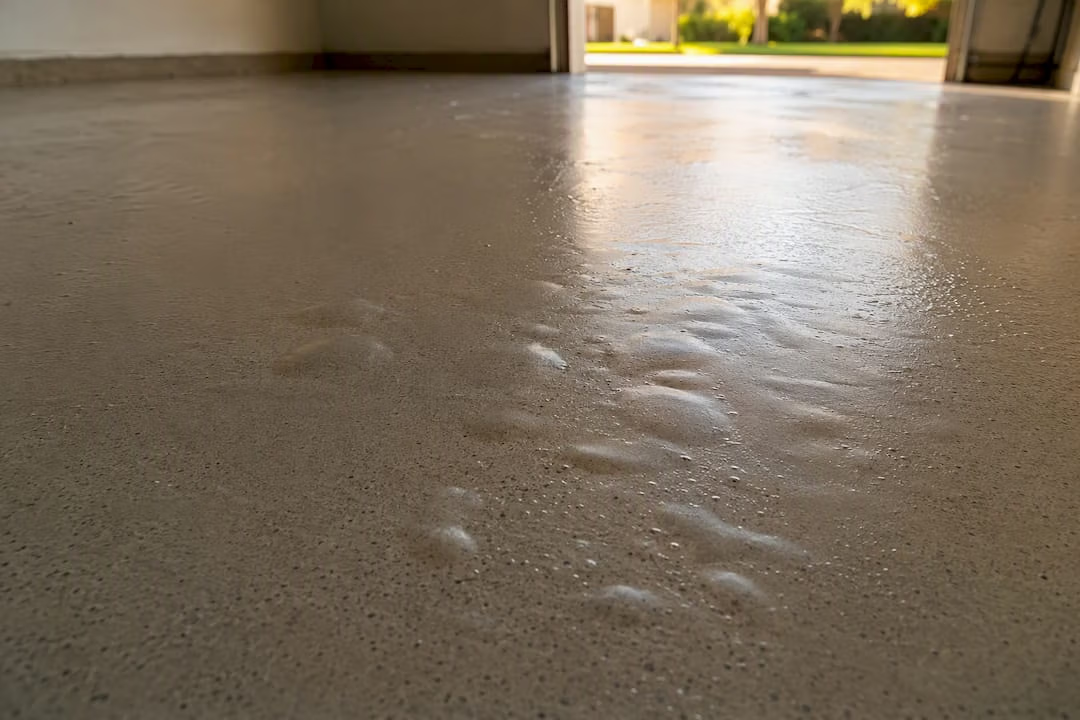
Heat makes it worse. Hot tires can literally pick up soft or under-cured thin epoxy, peeling small patches away as the car pulls out. Some epoxy chemistries also yellow and become brittle under UV exposure, which compounds wear in sun-exposed garage entries.
Pro Tip: If you see a faint outline of a tire tread lifted off the floor near where a car regularly parks, that’s a hot-tire pickup signature, not a random defect. It almost always means the film was too thin or not fully cured before the vehicle sat on it.
What A Professional Does To Prevent It
A competent installer follows a sequence that catches nearly every failure mode before the coating ever touches the slab.
- Moisture testing first. ASTM F1869 calcium chloride testing measures vapor emission rate, and ASTM F2170 uses in-situ relative humidity probes drilled into the slab. Professionals run a minimum of three tests per 1,000 square feet, not one test for the whole garage. Typical pass thresholds run around 3 lb MVER or 75% RH for standard epoxy systems, and up to 5 lb or 80% RH for moisture-tolerant polyaspartic systems.
- Diamond grinding to spec. Different systems need different Concrete Surface Profiles: CSP 2 to 3 for thin-mil flake and polyaspartic systems, CSP 3 for 100% solids epoxy, and CSP 4 to 5 for self-leveling builds. Grinding is repeatable and verifiable; acid etch is not.
- Degreasing and deeper remediation. Surface cleaners handle light residue. Deep oil penetration sometimes requires scabbling or partial removal of the affected concrete before coating can bond at all.
- Primer matched to the slab. Porous, older slabs starve a coating of resin if there’s no primer coat to seal them first. Matching primer chemistry to slab porosity and topcoat system prevents dry, chalky spots.
- Verified film thickness. Wet-film thickness gauges confirm mil build during application, not after the fact, which is the only way to guarantee the coating meets spec across the whole floor.
- Environmental controls. Checking dew point, slab surface temperature, and working within the material’s pot life and recoat window keeps cure quality consistent. A typical two-car garage takes 1.5 to 3 days once degreasing, grinding, crack repair, and testing wait times are factored in.
- Material selection. When a slab tests borderline for moisture or the garage gets heavy sun exposure, installers often step up to polyaspartic over standard epoxy for its better moisture tolerance and UV stability.
What To Do If Your Floor Is Already Failing
Start by documenting, not diagnosing. Photograph bubbles, edge lift, or tire pickup marks with something for scale, note the date, and jot down recent weather and how the garage gets used.
- Note whether the damage is isolated (one tire lane) or spread across the whole floor
- Stop parking or dragging heavy equipment over the affected area immediately
- Don’t attempt your own moisture testing beyond noting where symptoms appear
- Ask any contractor whether they run ASTM moisture testing and diamond grinding before quoting a fix
- Walk away from anyone who won’t put a written scope and mil specification in the estimate
Pro Tip: A coating that failed once because of untested moisture will fail again if a contractor just patches over it without testing and grinding. Spot repairs over an untreated root cause almost never hold.
Installer Perspective: What Proper Prep Actually Buys You
Every job Precision Concrete Coating in Conroe TX runs starts with documented moisture testing, diamond grinding to the correct CSP, and crack repair before a drop of coating goes down. Mil thickness and finish are specified in writing, not eyeballed.
That process is why the company backs residential work with a 15-year warranty. It costs more upfront than a thin retail kit. It costs a lot less than repairing the same floor three times in five years.
— William
Get Your Garage Floor Tested And Prepped Right The First Time
If your current coating is failing, the fix isn’t a thicker coat of paint over the same untested slab. It’s starting over with the process that prevents the failure in the first place: moisture testing, diamond grinding, and a coating specified at the correct mil thickness for how you actually use your garage.

Precision Concrete Coating in Conroe TX builds every estimate around that sequence, documented moisture readings, surface preparation verified to the right CSP, crack repair, and a written mil specification, backed by a 15-year residential warranty on the finished floor. If your garage in Conroe or the surrounding North Houston area is showing bubbles, peeling, or tire pickup, request a written assessment and get a real diagnosis before you spend money on another patch job.
Sources
- Concrete moisture testing and mitigation — AMPP
- Concrete prep for garage floor coatings: grinding, moisture & why coatings fail — 30DayPivot
- Why epoxy floors fail: the 9 real causes — National Epoxy
- Your DIY epoxy started peeling and now you have two bad options — Top Gun Garage
FAQ
How Quickly Can A Thin Coating Fail?
Thin DIY coatings under 10 mils can start peeling within 1 to 2 years, especially in tire lanes or areas with untested moisture.
Can I Just Patch The Bubbled Or Peeling Area?
Usually no. Patching over untested moisture or contamination without removing the failed layer typically leads to repeat failure in the same spot.
Is Polyaspartic Better Than Epoxy For Moisture-Prone Slabs?
Polyaspartic systems tolerate moisture and UV exposure better than many epoxies and resist hot-tire pickup more reliably, making them a common recommendation for sun-exposed or borderline-moisture garages.
How Long Does A Professional Re-Coat Take?
A typical two-car garage needs 1.5 to 3 days once degreasing, grinding, crack repair, and moisture testing wait times are included.
What Should I Ask A Contractor Before Hiring Them?
Ask whether they run ASTM F1869 or F2170 moisture testing, grind to a specific CSP target, and put mil thickness in writing. Precision Concrete Coating in Conroe TX includes all three in every written scope.