
Diamond grinding is the step that decides whether a garage floor coating lasts or peels. A grinder fitted with diamond abrasives removes the weak top skin of the slab, cleans off old coatings and gives the new coating a rough, open surface to grip. Done properly, it is also the dustiest, loudest and most technical part of the job, and it is the part you will never see once the floor is finished.
This guide explains what grinding actually accomplishes, what a floor looks like afterward, how it fits with crack repair and moisture testing, and what to ask before you sign with an installer in Conroe or North Houston.
TL;DR
- Grinding is not just cleaning. Its job is to create a Concrete Surface Profile (CSP) that anchors the coating.
- Skipped or poorly done preparation is the most common reason coatings delaminate, and it is often blamed on “bad” epoxy.
- Grind marks are expected and are covered by the coating system. Ask for the profile to be checked against the manufacturer’s requirement.
- Professional grinding needs dust control with a HEPA-filtered vacuum, as OSHA’s silica rule describes.
- Moisture testing comes before grinding and coating, not after a problem shows up.
Table of Contents
- What diamond grinding does to a garage slab
- What a ground floor looks like
- Preparation is a sequence, not one pass
- Moisture comes before the grinder
- Dust, silica and your attached garage
- Should you rent a grinder and do it yourself?
- Our perspective on preparation
- What grinding means for your coating options
- Protecting the slab before and after coating
- Questions to ask before you hire
- Cost and getting an estimate
- FAQ
- Sources
What diamond grinding does to a garage slab
A finished concrete slab has a smooth, dense surface layer. It looks solid, but it is a poor base for a bonded coating. It can hold curing compounds, oil, sealers and laitance (a weak, powdery film). A coating applied over that layer sticks to the film, not to the slab.
A diamond grinder is a walk-behind machine with rotating heads that carry metal-bonded diamond segments. As the heads turn, they shave the surface down and open the pores of the concrete. The result is a clean, uniformly textured surface with far more area for resin to bond to.
The goal has a name. The International Concrete Repair Institute defines Concrete Surface Profiles from CSP 1 (almost smooth) to CSP 10 (roughness above 0.25 inch). Diamond grinding is one of several ways to reach a profile suited to a bonded coating, and the exact profile depends on the coating product. Thin coatings need a finer profile. Thicker systems tolerate and often require a rougher one.
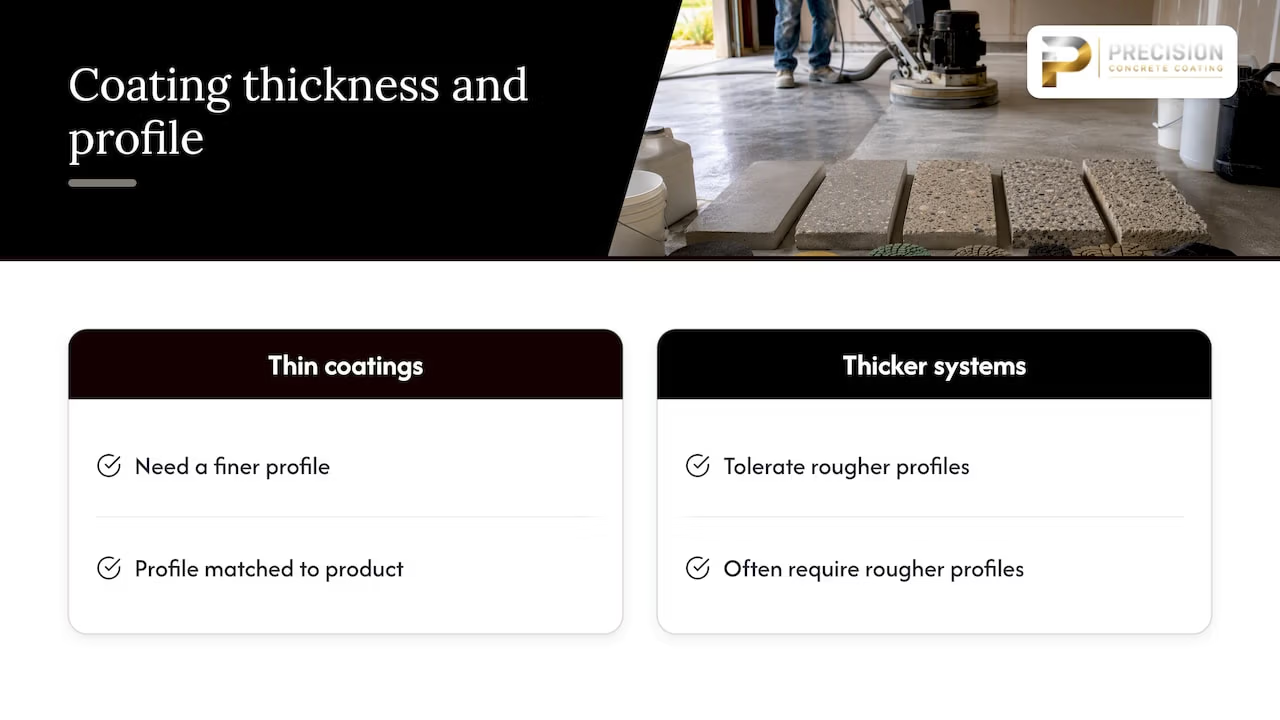
That is why a good installer does not say “we grind everything the same.” The profile is chosen to match the system going on top.
Why grinding beats acid etching and shot-blasting claims
There is no single ideal preparation method for every situation, and we will not pretend otherwise. ICRI’s guidance on selecting surface preparation compares methods for sealers, coatings and overlays. For most residential garages, diamond grinding is a strong fit because it:
- removes old paint, sealers and thin coatings in the same pass
- gives a controlled, repeatable profile
- leaves the slab level enough to patch and coat cleanly
- can be paired with a dust-collecting vacuum, which matters for an attached garage
Acid etching, a common DIY kit step, is hard to control and leaves residue that needs neutralizing. We do not recommend it as a substitute for mechanical preparation on a floor we are warranting.
What a ground floor looks like
Many homeowners searching for grind marks before coating are worried because the floor looks scratched and uneven right after grinding. That is normal. A freshly ground slab looks flat, matte and gray, sometimes with swirl patterns or faint lines from the grinder heads, and with different shades where the concrete’s density varies.
What matters is not whether the floor is pretty at that stage. It is whether the surface is:
- Clean. No old coating, glue, paint or oil residue left in patches.
- Consistent. The same texture across the whole slab, including edges and corners, which large machines often miss and need hand grinders.
- Sound. No loose or crumbling concrete left behind.
- Dry and free of dust. Vacuumed, not just swept.
Grind marks are not a defect for a typical garage system. A full-flake or solid-color system fills and buries them. Where deep gouges are left, they are filled and leveled before coating. A thin, clear or translucent coating is different: it can show deep scratches, which is one reason metallic and clear finishes call for finer finishing and more patching.
Over-grinding is a real risk
More is not always better. Aggressive diamond tooling can dig past the layer you meant to remove, leaving low spots and exposed aggregate. Over-grinding creates more patching and can change how much material the coating needs. Operators who know the machine adjust tooling, weight and speed to the slab, rather than running the heaviest setup across the whole floor.
Preparation is a sequence, not one pass
Grinding is the center of preparation, but it sits between other steps. A sound sequence for a residential garage looks like this:
- Inspect the slab. Look for cracks, spalls, pitting, oil stains, old coatings and signs of moisture.
- Test moisture. More on this below.
- Repair cracks and pitting. Fill and level before grinding or between grinding passes, depending on the repair material.
- Diamond grind to the profile the coating requires, then hand-grind edges.
- Vacuum with HEPA-filtered equipment.
- Install the system, for example a base coat, decorative flake broadcast and a UV-stable polyaspartic topcoat.
ACI 515.3R-20, a guide on assessing and preparing concrete for protection systems, states that surface preparation is among the most common causes of protection system failure. It also says assessment of the existing concrete, including contaminants and moisture, comes before the work begins.
If you want to see how cracks fit in, our concrete crack repair page covers it. Cracks that are only filled and ground flush, without the right repair material, can telegraph through a coating.
Moisture comes before the grinder
Grinding a slab that is releasing moisture does not fix the moisture. A coating over a wet slab can bubble, blush or debond.
The standard way to measure it is ASTM F2170, which uses in-situ probes to read relative humidity inside the slab. The standard notes that excess moisture in a slab can cause debonding and deterioration of coatings and microbial growth, and manufacturers of such systems generally require moisture testing before installation.
Two practical points for Texas garages:
- Slabs on grade in the Houston area sit on soil that stays damp for much of the year. A slab that feels dry on top can still be reading high at depth.
- Many contractors write “protection by others” into contracts. As the Concrete Polishing Council’s position statements describe, protecting the slab from moisture often falls to the general contractor or owner, not the coating installer. Ask what your installer does if a test reads high, and what the warranty says about it.
We go deeper on this in our moisture mitigation checklist and in our note on requiring ASTM F2170 before you coat. If you want a quick homeowner check on an existing floor, see two simple tests for moisture under epoxy.
Dust, silica and your attached garage
Grinding concrete produces respirable crystalline silica. This is a health hazard, and in the workplace it is regulated. OSHA’s rule at 29 C.F.R. § 1926.1153 specifies engineering controls for tasks like this, including a vacuum dust collection system with a HEPA filter. OSHA’s own guide to walk-behind milling machines and floor grinders explains that these machines can generate silica dust.
What this means for you as a homeowner:
- A grinder connected to a shop vacuum is not the same as a purpose-built dust extractor with a HEPA filter.
- If your garage is attached, dust can travel into the house through doors, ducts and gaps. Ask how the crew seals the doorway and what they use to capture dust at the machine.
- Ask to see the equipment. An installer who cares about the process will be glad to show you.
Our article on epoxy in an attached garage covers airflow, which matters during the coating stage too.
Should you rent a grinder and do it yourself?
It is a fair question, since many top search results are DIY threads. Here is the honest picture. Renting a grinder is possible, and some careful owners get decent results on a small, clean, uncoated slab. But the risks add up:
- Profile. Without CSP chips, it is hard to know what profile you made.
- Dust. Rental setups often lack proper HEPA collection, which is the exact issue the OSHA rule addresses for professional work.
- Edges and corners. These need a second tool and patience.
- Moisture and cracks. Grinding does not reveal or solve them.
- Warranty. A coating you apply over your own prep has no installer standing behind the bond.
If you decide to go the professional route, our garage floor installation page outlines how we handle a job from start to finish.
Our perspective on preparation
We built our business around preparation because it is where coating jobs are won or lost. Most callbacks in this trade are not a chemistry problem. They are a bond problem, and a bond problem begins at the grinder.
Our process starts with mechanical diamond grinding, crack and pitting repair, and moisture testing before any coating goes down. That is what makes our 15-year residential warranty possible. We are locally owner-operated, so the person who sells the job oversees the work.
What we want homeowners to know:
- The grinding profile should match the system. A floor with a decorative flake and polyaspartic topcoat does not have the same needs as a thin clear coat.
- A floor that looks “rough” after grinding is a good sign, not a bad one.
- Ask any installer, including us, what happens if the slab tests high for moisture.
- Prep time is not padding. If a quote leaves it out, ask where the cost went.
— William
What grinding means for your coating options
Once the slab is prepared, the finish you choose changes how visible the preparation is and how the floor performs.
| Finish | How grinding affects it | Where to read more |
|---|---|---|
| Full-flake decorative system | Flakes and base coat hide grind texture well | Decorative flake garage floors |
| Solid-color epoxy | Needs even patching and leveling first | Garage floor coatings |
| Metallic epoxy | Shows surface flaws more, so finish quality matters | Garage floor coatings |
| Polyaspartic topcoat | UV-stable protective layer over a properly profiled slab | Polyaspartic coatings |
| Polished concrete | Uses progressively finer diamond steps instead of a coating | Polished concrete pros and cons |
If you are weighing coatings against cheaper options, our comparison of garage floor tiles, paint and epoxy lays out the tradeoffs.
Protecting the slab before and after coating
The Concrete Polishing Council’s position statements make a point many owners miss: the installer is often on site only for the grinding and coating phase. Protecting the floor from other trades, spills and heavy equipment before and after the work is a planning job for you.
Three habits help:
- Schedule coating after messy trades such as drywall, painting and equipment installation.
- Keep new storage off the floor in the days after coating, and plan how it will be fastened. If you are adding a shed or cabinets, this guide on anchoring a resin shed shows how to fix storage to a slab without cracking it.
- Use mats under jacks, stands and tools until the coating has fully cured. Our page on polyaspartic cure time explains when you can drive on it.
Questions to ask before you hire
Use this list on every quote, including ours:
- Do you grind with diamond tooling, and with a HEPA-filtered dust collector?
- What profile do you target, and how do you check it against the manufacturer’s requirement? ICRI sells CSP chip sets that serve as the benchmark.
- Do you run a moisture test, and which one?
- How are cracks and pitting repaired?
- What is in the warranty, and what does it exclude?
- Who is on site overseeing the work?
Cost and getting an estimate
Grinding is built into the preparation of a professional job rather than sold as a separate line in most cases, so the useful number is the cost of the finished system. Our published ranges are $4.50 to $7.50 per square foot for garage floor coatings, with patio and pool deck coatings at $5.00 to $8.00 per square foot. Your final price depends on the slab’s condition, repairs needed and the system you choose, and you get a written estimate before any work starts.
If you are in Conroe or the surrounding North Houston area and want a floor prepared the right way, see our garage floor coating pricing and estimate page or start with our Conroe garage floor coatings. Our residential work carries a 15-year warranty.
FAQ
How long does diamond grinding a garage take?
For a typical one- or two-car garage, grinding is usually part of a one-day preparation stage, but the time depends on slab size, hardness and old coatings. Crack repair, moisture testing and curing of patch materials add to the overall schedule. We confirm the timeline in your written estimate.
Do grind marks show through the coating?
With flake systems and solid-color epoxy, normal grind marks are covered by the coating. Deep gouges are patched first. Thin clear or metallic finishes reveal more, so those floors need finer finishing and more leveling.
Is grinding enough, or do I need moisture testing too?
You need both. Grinding builds the profile for adhesion, while a test such as ASTM F2170 tells you whether moisture inside the slab could push the coating off. Manufacturers generally require moisture testing before installation.
Is garage floor grinding dangerous?
Grinding concrete creates respirable crystalline silica dust, which OSHA regulates on job sites. Professional crews use HEPA-filtered vacuum dust collection. If you have breathing problems or the garage is attached to living space, ask the installer about dust containment and talk to your doctor if you have concerns about exposure.
Sources
- ICRI: Selecting and Specifying Concrete Surface Preparation
- ACI 515.3R-20 guide preview
- ASTM F2170 standard
- ASTM F2170-16 significance and use
- Concrete Polishing Council position statements
- OSHA 29 C.F.R. § 1926.1153
- OSHA guide to walk-behind milling machines and floor grinders
- ICRI CSP chip set bundle
2 Responses