
For most residential garages, 1/4-inch flake is the safe, classic choice. It shows clearly from the driveway, hides dirt and tire marks well, and gives the floor a bold, textured look. Choose 1/8-inch or a blend if you want a calmer, finer, more stone-like surface. Choose 1/16-inch only if you want a subtle, almost speckled finish. Whatever size you pick, the chips only decorate the floor. Whether the floor lasts depends on the prep underneath and the clear coat on top.
Below, we explain how each size looks and feels, how much flake a typical two-car garage takes, and which decisions to make before you pick a color.
TL;DR
- 1/4" is the standard garage size: bold, high-contrast, and the best at hiding dirt. 1/8" is finer and quieter. 1/16" is the most subtle.
- A two-car garage of roughly 450 to 500 square feet takes about 50 lb of 1/4" flake or about 75 lb of 1/8" or 1/16" flake, according to one manufacturer’s guide.
- Flake size and coverage density work together. A full broadcast hides the base coat and small slab flaws. A light scatter shows more of the base color.
- Chips don’t repair concrete. Cracks, pitting and moisture need handling before any flake goes down.
- Garage coatings from Precision Concrete Coating run $4.50 to $7.50 per sq ft, with a 15-year residential warranty available.
Table of Contents
- The common flake sizes, side by side
- How flake size changes the look
- Density matters as much as size
- Texture, grip and cleaning
- How much flake does a garage need?
- Settle these before you pick a flake size
- Can you add flakes to garage floor paint?
- Our perspective: size is the fun part, prep is the part that lasts
- What a flake floor costs in Conroe
- A quick way to choose
- FAQ
- Sources
The common flake sizes, side by side
Decorative flakes are small colored chips, usually vinyl or mica, that are thrown into a wet base coat and then sealed under a clear topcoat. Sizes in the industry run from about 1 inch for oversized chips down to 1/16 inch for micro flakes, as one epoxy floor style guide frames it for the 1/4 versus 1/8 choice. For a home garage, three sizes cover nearly every job.
| Size | Look | Texture | Best for |
|---|---|---|---|
| 1/4" | Bold, high-contrast, visible chips | More pronounced | Two-car garages, hiding dirt, a classic flake look |
| 1/8" | Refined, softer blend, still has depth | Moderate | Homeowners who like flake but want it quieter |
| 1/16" | Fine, speckled, granite-like | Smoothest | Small spaces, subtle finishes, easy wiping |
The table describes typical behavior. Your results depend on the blend you choose, how heavily the flake is broadcast, and the topcoat.
How flake size changes the look
The general principle is simple. Torginol, a flake manufacturer, notes that smaller flakes create natural, aggregate-like appearances, while larger flakes suit bold, graphic patterns that read well in bigger spaces. A garage is a big, plain space, which is why 1/4" dominates there.
1/4-inch flake
This is the size most people picture when they say “epoxy flake garage floor.” Each chip is large enough to see individually, so the floor has a visible, patterned character. It stands out from far away, which suits a two- or three-car garage where you view the floor from the driveway with the door open.
The pattern also camouflages. Oil drips, dust, tire marks and the odd scuff vanish into a busy field of color. That is a major reason owners of working garages pick it.
1/8-inch flake
A finer chip gives a smoother, more uniform look with less visual noise. Up close you still see individual flakes, but from across the garage the floor reads as one textured color. It suits homeowners who want the benefits of a flake system without the busy pattern, or who have a modern, minimal home exterior.
1/16-inch flake
Micro flake looks like fine speckle, similar to granite or terrazzo. It suits small spaces, utility rooms, workshops and anyone who wants the quietest look. It hides less than larger chips, so the base coat and the floor’s condition matter more.
Blends and mixed sizes
Many color blends combine several shades in one size, and some systems mix sizes. A multi-shade blend in the middle of the color range hides dirt best, because no single dirt color stands out. Pure black or pure white flake is the hardest to live with: black shows dust and white shows tire marks. For a closer look at dark floors, see our guide to black garage floors and how flakes hide dirt.
Density matters as much as size
Size is only half of the look. How much flake you throw decides how much of the base coat shows. A ShowFloor guide treats flake size and density as linked decisions rather than separate ones. Someone who wants a high-contrast, busy floor should combine larger flakes with a full broadcast. Someone who wants a calm, stone-like surface should consider smaller or blended flakes.
There are two broad approaches:
- Partial broadcast: flakes are scattered so some base color shows through. This gives a lighter, more speckled look and uses less material.
- Full broadcast: flakes are thrown to rejection, meaning the wet base coat won’t accept any more. The base is completely covered, the surface is textured, and the excess is swept up and removed after curing.
For garages, a full broadcast is the common choice. It hides the base color and minor surface variation, and it builds body and texture. We install full-flake systems for this reason. You can see the options on our decorative flake garage floors page.
Texture, grip and cleaning
Flake size changes how the surface feels underfoot and how it cleans.
- Larger chips create slightly more surface relief. After sealing, you can feel the bumps with a bare hand or a wheel. That relief can add grip, but it also holds a bit more grime in the low spots.
- Smaller chips leave a smoother surface that wipes and mops easily, because there’s less relief to trap dirt.
The topcoat controls the rest. A clear coat over the flakes seals them in and gives a wipeable surface. If grip in wet conditions matters to you, such as a garage where you hose off or where the kids ride bikes in, ask about slip resistance specifically. Our article on anti-slip additives versus flakes covers how to ask for proof. Sheen also affects how the floor looks and how dirt shows, which we cover in gloss versus matte garage floors.
One more point on materials: vinyl and mica flakes behave differently under UV light and in a clear coat. If your garage gets direct sun through a door or windows, our comparison of mica versus vinyl flakes is worth reading before you choose a color.
How much flake does a garage need?
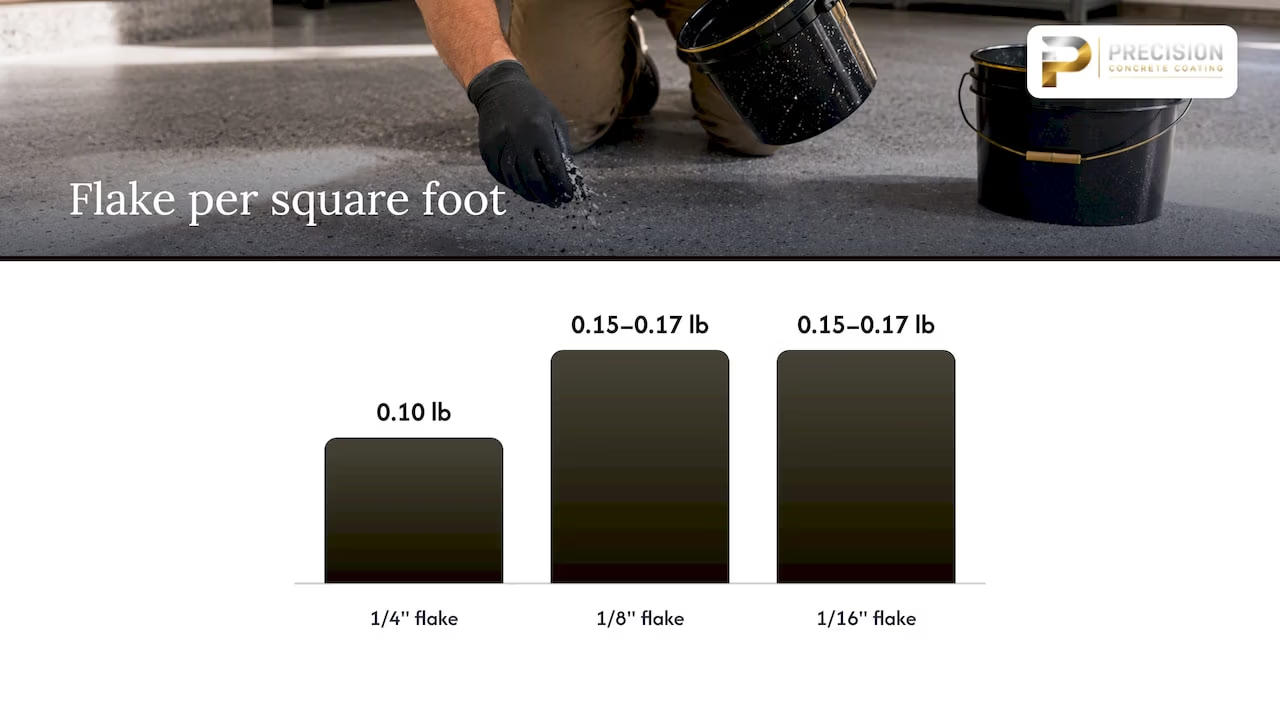
Coverage depends on the chip size and how heavily you broadcast. Versatile, a coatings manufacturer, lists 50 pounds of 1/4-inch flake or 75 pounds of 1/8- or 1/16-inch flake for a two-car garage of 450 to 500 square feet. That works out to roughly 0.10 lb per sq ft for 1/4" and roughly 0.15 to 0.17 lb per sq ft for the finer sizes, by our arithmetic. Smaller chips need more weight to cover the same area because they pack in tighter and are lighter per piece.
A few practical notes:
- Measure the real area. Length times width, minus anything permanent such as a workbench footprint if you’ll coat around it.
- Plan on leftover. A full broadcast uses more than the final coverage suggests, because the excess is swept off after curing.
- Order from one batch. Flake color can vary slightly between lots, so a single order avoids a visible seam.
If you hire a professional installer, the crew calculates and orders this for you. The material is part of the quote. You don’t need to do the math yourself unless you want to compare estimates.
Settle these before you pick a flake size
Getting the chip size right won’t help if the floor underneath is failing. A GarageFloorFlake guide makes the point that flakes should never stand in for proper concrete repair. Slab imperfections have to be dealt with before the decorative system goes on. We agree completely.
Here is what we check on every garage before flakes enter the conversation.
Surface preparation
Coatings grip a profile, not a smooth, sealed surface. We use mechanical diamond grinding to open the concrete and remove contaminants and weak surface layers. Our article on diamond grinding a garage floor explains what to expect on the day. Older slabs often have more to deal with, which we cover in epoxy for old concrete.
Cracks and pitting
Cracks, spalls and pitting show through a thin coating, and large chips don’t hide structural movement. We fill and repair them before coating. See our concrete crack repair service for how we handle it.
Moisture
Moisture vapor moving up through a slab can push a coating off the floor. We test before we coat, and where the test calls for it we mitigate. Our moisture mitigation checklist lists the checks a homeowner can ask any contractor about. Texas heat and humidity make this more than a formality. For a related look, read about epoxy in hot climates.
Brand-new slabs
A new slab can look ready and still not be. Waiting 28 days is not enough on its own. Our page on epoxy on new concrete explains why.
Can you add flakes to garage floor paint?
Short answer: not in any way you should count on. Flakes are designed for a coating system with a base coat thick enough to hold them and a clear topcoat to lock them in. Scattering chips onto thin garage floor paint leaves them poorly bonded and exposed, so they wear and lift. Paint also performs differently from epoxy and polyaspartic systems on hot tires, chemicals and abrasion. Our comparison of garage tiles, paint and epoxy walks through the tradeoffs.
If you want flakes, plan for a flake system: a prepared floor, a base coat, a broadcast, and a sealing topcoat. We use a UV-stable polyaspartic topcoat over the flakes for protection and a clean finish.
Our perspective: size is the fun part, prep is the part that lasts
We get asked about flake size on almost every garage estimate, and it’s a good question. Color and size decide whether you smile when you pull in. But in our experience, the floors that disappoint owners years later didn’t fail because of the chip choice. They failed because someone skipped the grinding, left a crack, or coated over a wet slab.

Our process is built around that. We grind the surface mechanically, repair cracks and pitting, test for moisture, and only then broadcast flakes. We are a local, owner-operated company, which means the person who sells the job stays involved in how it goes on. That prep-first approach is why we can offer a 15-year residential warranty.
For most garages here in Conroe and North Houston, we recommend a full broadcast of 1/4" flake in a multi-tone blend, sealed with polyaspartic. It looks good, it hides the dirt a real garage collects, and it holds up to a Texas summer. If you prefer something quieter, we’re happy to show you 1/8" and 1/16" samples in person. Looking at a sample in your own garage light beats any online photo.
— William
What a flake floor costs in Conroe
Our garage floor coatings are priced at $4.50 to $7.50 per sq ft. The final figure depends on the condition of your slab, the repairs it needs, and the system you choose. For a 500 sq ft garage, that range works out to $2,250 to $3,750, by simple multiplication of our published rate. A written estimate gives you the exact number for your floor.
If you’re ready to see what your garage would cost, start on our cost and estimate page, or look at our garage floor coating systems to compare flake, solid color, metallic and polished options. Bringing a photo of your garage and a rough size helps us give you a quicker answer.
A quick way to choose
- Do you want the floor to hide dirt and wear? Go with 1/4" in a multi-tone blend, full broadcast.
- Do you want a quieter look? Try 1/8" or a blended size.
- Is the space small, or do you want the smoothest surface? Consider 1/16".
- Is your slab cracked, stained or old? Fix that first. Chip size won’t hide it for long.
- Does the garage get strong sun or heat? Ask about UV-stable topcoat and flake material.
- Not sure? Look at physical samples in your garage lighting, in daylight and with the lights on.
Our guide to epoxy flake floors and why color won’t fix bad prep goes deeper on that last point if you’re comparing quotes.
FAQ
What is the most popular flake size for a garage floor?
The 1/4-inch chip is the most common choice for residential garages. It gives a bold look from a distance and hides dirt well. The finer 1/8-inch and 1/16-inch sizes are chosen when homeowners want a quieter or smoother surface.
Does flake size affect durability?
Not in a meaningful way. Durability comes from the surface prep, the base coat, and the clear topcoat that seals the chips in. Flake size mainly changes the look, the surface texture and how much material the job takes.
Can I mix flake sizes?
Yes, some blends combine sizes or shades to get depth. Keep the mix simple, though, and look at a sample board first. Too many contrasting colors in different sizes can look busy on a large floor.
Can flakes hide cracks and stains in my concrete?
They can hide small surface variations, especially at full broadcast. They can’t fix cracks, pitting or moisture problems, and those can show up or fail through the coating later. We repair them first so the finished floor stays smooth and bonded.
Sources
- Size Matters (FLAKE size that is…), Torginol
- 1/4" vs. 1/8" Garage Floor Flake: What’s the Difference?, GarageFloorFlake.com
- Full vs Partial Broadcast Epoxy Flake, ShowFloor AI
- Choosing the Correct Amount of Roll On Rock Flakes, Versatile