For long-term durability and low upkeep, a professionally installed epoxy or polyaspartic coating usually outperforms paint, while modular tiles are the strongest DIY option when a fast install and easy repair matter most. Paint alone tends to wear out quickest under tires and chemicals. The right pick also depends heavily on your slab: poor moisture control or weak prep can shorten the life of any of the three.
TL;DR:
- Paint films often peel or wear within 1 to 3 years under vehicle traffic, and worn patches need sanding and touchups every year or two.
- Before coating, test slab moisture, repair cracks, and mechanically grind the concrete; skipped prep or unresolved dampness can cause delamination.
- For heavy loads, dense PVC tiles resist point pressure better than polypropylene, but they can trap moisture unless the slab is sealed.
- Tiles need occasional lifting to clear grit and moisture underneath, while coatings usually need sweeping and occasional mopping; damaged tile sections can be replaced individually.
Table of Contents
- How do garage tiles, paint, and epoxy compare at a glance?
- What actually makes each surface fail or hold up?
- How much upkeep and repair does each option demand?
- What does proper surface prep actually involve?
- What will each option cost you over time?
- What finish options exist for color, texture, and grip?
- How do you choose between tiles, paint, and epoxy?
- How do professional installers avoid the common failure points?
- Is a DIY floor ever the smarter call?
- Where our prep-first approach fits your garage
- FAQ
- Sources
How do garage tiles, paint, and epoxy compare at a glance?
Each option trades speed and cost against durability and finish quality.
- Paint: cheapest and fastest, but thin films peel or wear within 1 to 3 years under vehicle traffic.
- Interlocking tiles: moderate cost, no cure time, and individual tiles can be swapped if damaged, though heavy point loads can deform some materials.
- Epoxy or polyaspartic coatings: highest upfront cost and the longest lifespan when installed with proper prep, typically lasting a decade or more.
- DIY fit: paint and tiles suit confident DIYers; multi-coat epoxy and polyaspartic systems generally call for a professional due to mixing ratios, timing, and surface profiling.
- Maintenance cadence: tiles need periodic lifting and cleaning underneath, paint needs frequent spot touch-ups, and epoxy or polyaspartic systems mostly need routine sweeping and occasional mopping.
What actually makes each surface fail or hold up?
Garage floor paint is a thin film, and thin films are the first thing to go under hot tires, dropped tools, and road salt. A laboratory and field study of thin-film coatings found that two-coat systems combining an epoxy primer with a urethane topcoat resisted chloride penetration far better than single-coat alternatives, with adhesion values ranging across multiple systems within a range typical of durable coatings. The same testing showed uneven color and gloss retention across products: most systems held a Delta-E under 4, a sign of good color stability, while one system lost nearly 20 Delta-E points and 45 gloss units after weathering, a visible sign of early breakdown.
Epoxy’s main failure mode isn’t wear, it’s delamination when moisture or contamination sits between the slab and the coating. Tiles handle chemical staining and cracking well because they aren’t bonded to the slab, but performance varies by material. Polypropylene tiles are lighter and let moisture move underneath them, while denser PVC tiles resist point loads better but can trap moisture if the slab underneath isn’t sealed, according to a practitioner comparison of tile materials.
How much upkeep and repair does each option demand?
Daily care is simple for all three, but repairs diverge sharply.
- Tiles: sweep or hose off, and lift sections occasionally to clear grit and moisture underneath.
- Paint: sweep regularly and expect to sand and re-touch worn patches every year or two.
- Epoxy or polyaspartic: damp-mop with a mild cleaner; full recoating is rare if the install was done right.
Oil and chemical spills behave differently on each surface. Tiles let you wipe up spills before they soak in, paint can absorb stains permanently once the film is scratched, and polyaspartic topcoats resist most automotive fluids if wiped promptly.
Pro Tip: Keep a box of baking soda or cat litter in the garage to blot fresh oil drips immediately, since dried stains are far harder to lift on any surface.
What does proper surface prep actually involve?
Surface prep determines whether a coating lasts years or peels within months. A contract specification for floor coating prep calls for new concrete to cure for a suitable period, typically several weeks, before coating and recommends moisture testing before any coating goes down.
- Inspect and clean the slab for oil, dust, and existing sealers.
- Test for moisture using the ASTM D4263 plastic-sheet method or a manufacturer-approved meter.
- Repair cracks and pits with epoxy filler or slurry before any coating touches the surface.
- Mechanically grind the concrete to open its pores and create a bonding profile; acid etching is a weaker substitute.
- Apply coatings within the manufacturer’s working window, then allow full cure before vehicle traffic.
Tiles need less prep: a clean, reasonably level slab is usually enough, since they aren’t bonded. Skipping moisture testing or grinding is the single most common reason epoxy delaminates, and ACI’s guidance for slabs under moisture-sensitive flooring points to unresolved slab moisture and pH as the dominant cause of coating failure, more than product quality itself.
What will each option cost you over time?
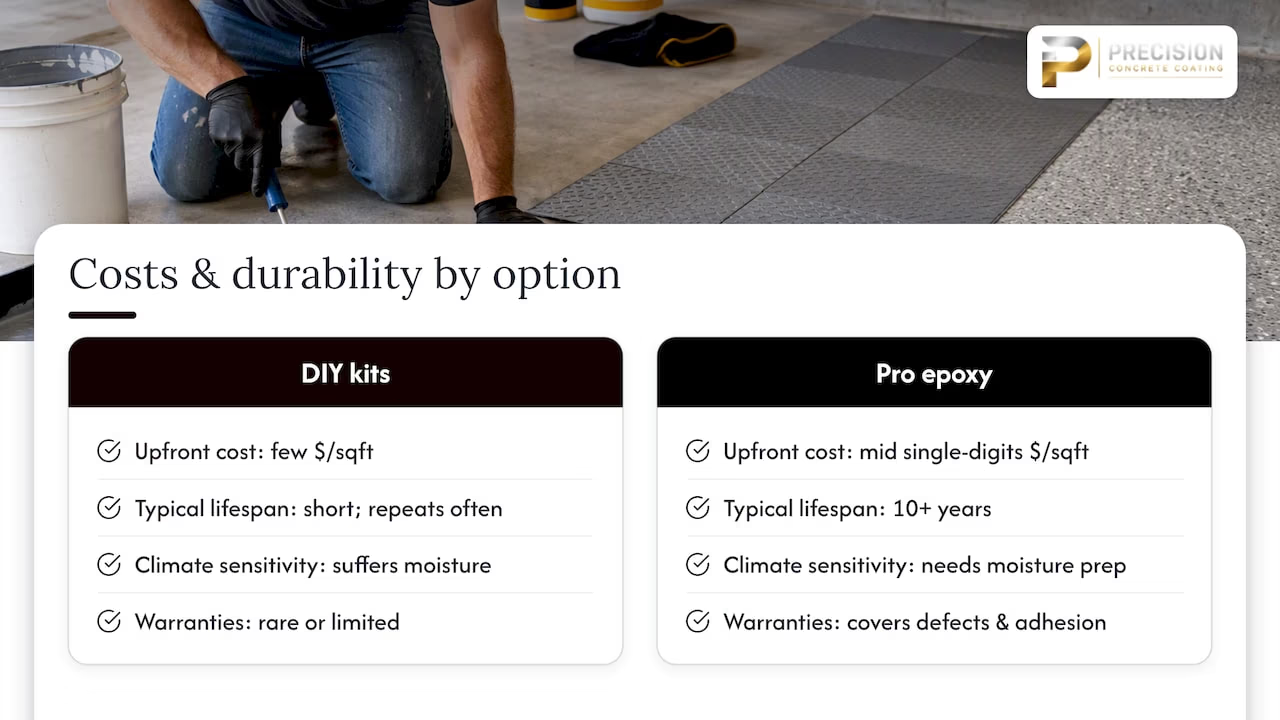
DIY paint and tile kits run cheapest upfront, often a few dollars per square foot in materials, but paint’s short lifespan means repeat purchases. Professionally installed epoxy and polyaspartic systems cost more at installation, generally in the mid single digits per square foot, but spread that cost over a decade or longer of service.
Climate and use change these numbers. A garage that floods seasonally or sits in a humid region stresses coatings faster unless moisture is addressed first, something the BASC/PNNL guidance on epoxy and moisture control stresses: epoxy coatings can reduce moisture transmission, but drainage problems have to be fixed before coating, not after. Warranties typically cover adhesion and material defects, not damage from skipped prep or unresolved water issues underneath.
What finish options exist for color, texture, and grip?
Tiles come in modular patterns and solid colors, swappable without redoing the whole floor. Epoxy and polyaspartic systems support full-flake broadcast blends, metallic finishes, and solid colors, with a sealed topcoat that holds gloss longer than paint under the same wear. Broadcasting aggregate or flakes into a wet coating also adds slip resistance, which plain paint and smooth tile surfaces lack unless textured. The tradeoff is permanence: a seamless coated floor looks continuous but can’t have a single section swapped out the way a damaged tile can.
How do you choose between tiles, paint, and epoxy?
Match the option to your slab condition, budget, and how you use the space.
- Check your budget first: tiles and paint cost less upfront; epoxy and polyaspartic cost more but last longer.
- Consider moisture history: a garage with past flooding or dampness needs testing before any coating goes down.
- Weigh DIY time against durability: paint is fastest to apply but shortest-lived.
- Think about repairability: tiles let you replace a single damaged section.
Three quick scenarios: a renter wanting a quick refresh fits paint or tiles. A homeowner with a cracked, damp slab who wants a floor that lasts 10+ years fits a professionally prepped epoxy or polyaspartic system. A heavy-use garage with jack stands or engine hoists fits dense PVC tiles with a plywood pad underneath, or a polyaspartic coating rated for point loads.
Pro Tip: Ask any contractor how they test for moisture and whether crack repair is included before quoting a price; a vague answer is a red flag.
How do professional installers avoid the common failure points?
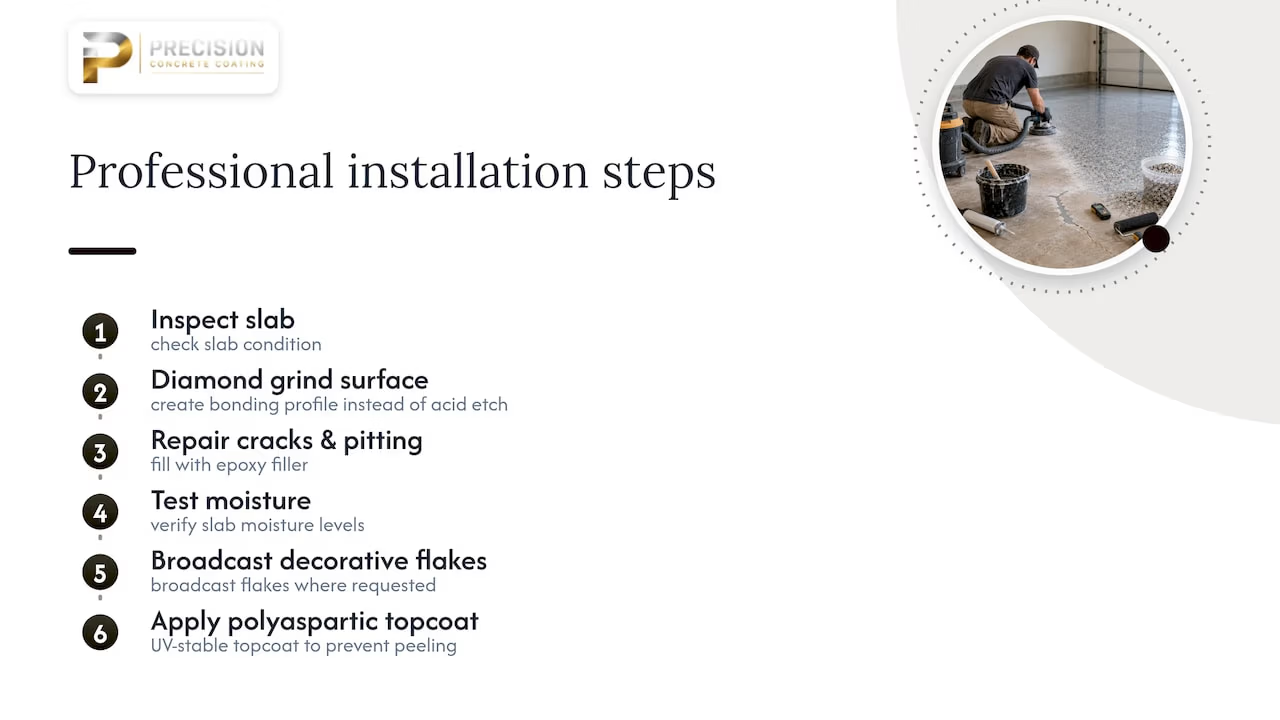
Our process starts with inspecting the slab, then mechanically diamond grinding the surface to create a bonding profile instead of relying on acid etching. We repair cracks and pitting with epoxy filler before testing moisture levels, broadcast decorative flakes where requested, and finish with a UV-stable polyaspartic topcoat. We back residential installations with a warranty, reflecting confidence in prep done correctly the first time rather than shortcuts that show up as peeling within a year or two.
Is a DIY floor ever the smarter call?
Pro coatings earn their cost when a slab has cracks, moisture history, or heavy daily use, since skipped prep is what actually causes early failure, not the material itself. Tiles or paint still make sense for a rental, a quick refresh, or a light-use space.
— William
Where our prep-first approach fits your garage
We built our process around the one thing most garage floor failures trace back to: prep that got rushed or skipped. Every job starts with diamond grinding, crack repair, and moisture testing before any coating goes down, and we back residential installs with a warranty because of it. If a damp slab or old cracks have made you hesitant about tiles or paint, a properly prepped epoxy or polyaspartic system solves the underlying problem instead of covering it up.

- Request a written estimate through our garage floor coating cost page to see pricing for your square footage.
- Browse system options, including full-flake, metallic, and solid-color epoxy, on our garage floor coatings page.
- Ask about crack repair separately through our concrete crack repair page if that’s your main concern.
Most estimates can be scheduled within a week of your first call, with installation timing depending on prep needs and cure windows.
FAQ
Are garage car mats worth it?
Car mats help catch drips and reduce tire wear on a finished floor, but they don’t replace a durable base coating or tile system underneath. They work best as a supplement over paint or epoxy, not as a standalone floor solution.
Which is better, epoxy floor paint or tiles?
Properly prepped epoxy or polyaspartic coatings generally outlast tiles in resistance to chemicals and abrasion, based on testing of two-coat epoxy-urethane systems. Tiles win on repairability and DIY speed, since damaged sections can be swapped without recoating the whole floor.
How much does 1,000 square feet of epoxy cost?
Professional garage floor coating installation typically runs at mid single-digit dollars per square foot, depending on prep and system chosen (https://precision-concretecoating.com/concrete-coating-cost-garage-patio-estimates). Getting a written estimate for your specific slab is the most accurate way to confirm pricing.
What are the drawbacks of using concrete epoxy?
Epoxy coatings can delaminate if the slab wasn’t properly moisture-tested or mechanically prepped beforehand, since unresolved slab moisture is the leading cause of coating failure. Full-coverage systems also can’t have a single damaged section easily swapped out the way modular tiles can.
9 Responses