A full flake floor is a resin coating system in which decorative flakes are broadcast over the wet base coat until none of the color underneath shows. The result is a textured, speckled, hard-wearing surface that hides dirt and concrete flaws, which is why it is the go-to finish for residential garages. Below you will find how it compares with a partial flake floor, what it costs in 2026, how a crew installs it, and the prep steps that decide whether it lasts.
TL;DR
- A full flake (full broadcast) floor covers the base coat completely with flakes, then seals it with a clear topcoat. A partial flake floor leaves base color showing between flakes.
- Full flake gives better texture, better camouflage for tire marks and stains, and a more forgiving surface. Partial flake costs a little less and looks smoother and more modern.
- Professional installs commonly run about $5 to $9 per square foot nationally. Our published garage floor range is $4.50 to $7.50 per square foot.
- Most failures trace back to preparation and moisture, not to the flakes. Diamond grinding and moisture testing come before any coating goes down.
- A UV-stable polyaspartic topcoat is what protects the flakes and keeps the floor easy to clean.
Table of Contents
- What a full flake floor actually is
- Full flake vs partial flake
- Choosing flakes: vinyl, mica, color and blend
- What a full flake floor costs in 2026
- How a full flake floor is installed, step by step
- Perspective: why we put prep ahead of flake color
- Moisture, heat and the Texas slab
- When a full flake floor is not the right answer
- Caring for the floor after install
- Get a full flake floor quote in Conroe
- FAQ
- Sources
What a full flake floor actually is
Picture a garage floor that looks like fine granite: a mix of tan, gray, black or brown chips, with a glossy or satin clear coat over them. That is a full flake system. It is built in layers:
- Prepared concrete. The slab is mechanically ground, cracks and pits are repaired, and moisture is checked.
- Base coat. A pigmented, two-part, 100% solids epoxy is rolled on. The base coat is the glue for the flakes.
- Flake broadcast. Decorative chips are thrown by hand into the wet base coat in heavy, repeated passes.
- Scrape and sweep. Once cured, loose flakes are scraped and vacuumed off, leaving a bonded, slightly rough surface.
- Topcoat. One or more clear coats lock the flakes in and smooth the surface. We use UV-stable polyaspartic for this layer.
The phrase “full broadcast” means the same thing as “full flake.” Installers also describe the goal as broadcasting to rejection: the base coat is saturated until it cannot accept any more flakes, and no shiny spots of base coat remain visible. Crews typically walk the wet base coat in spike shoes and make several passes so coverage is total. If you can see glossy patches of base color after the first scrape, the floor was under-broadcast, and those areas wear and feel different from the rest.
Full flake vs partial flake
People searching “full vs partial flake” usually want to know whether the extra material is worth it. The difference comes down to coverage, and coverage drives look, texture and how forgiving the floor is.
| Full flake (full broadcast) | Partial flake | |
|---|---|---|
| Flake coverage | 100%, base coat fully hidden | Roughly a light to medium scatter, base color shows |
| Look | Dense, speckled, granite-like | Solid color with accents, more open |
| Hides stains, tire marks, dust | Very well | Moderately |
| Hides slab flaws and patches | Best | Some patches can show through |
| Texture and grip | Noticeably textured | Smoother |
| Material and labor | More flake, more scraping, more topcoat to fill the texture | Less of each |
| Best for | Daily-driver garages, workshops, families | Showroom-style or low-traffic spaces |
Two practical points sit behind the table. First, texture matters for safety. Contractors interviewed in a trade article on garage epoxy describe a “happy medium” between an easy-to-clean surface and slip resistance, and point out that a high-gloss, perfectly smooth floor can get dangerously slippery when wet. Flake density is one of the ways installers build in that texture without sacrificing looks. If wet traction is your main worry, read our comparison of anti-slip additives versus flakes before deciding.
Second, camouflage matters more than people expect. Garage slabs carry oil drips, brake dust, hot-tire marks and years of patched cracks. A full flake floor is the finish that makes all of that disappear. If you are leaning toward a dark palette, our notes on black garage floors and flakes explain why flakes hide dirt that a solid black coating would show.
When does partial flake make sense? When the slab is in excellent shape, you like a cleaner and more minimal look, and you want to trim the budget a bit. For most Texas garages that park two cars, store tools, and see sand and water tracked in, we recommend full flake.
Choosing flakes: vinyl, mica, color and blend
Flakes are small pieces of colored material, most often vinyl chips. Mica-based flakes are another option that shimmers differently under light. Which one suits your garage depends on how it will be used, and we walk through the trade-offs in mica versus vinyl flakes for home garages.
A few guidelines we give homeowners:
- Pick a multi-color blend over a single color. Blends with three or more tones hide dust, footprints and small imperfections better than a single flat tone.
- Mid-tones beat extremes. Very light floors show tire marks. Very dark floors show dust and chalky residue. Grays, tans and browns with some contrast are the easiest to live with.
- Match the base coat to the flakes. Even in a full broadcast, the pigmented base coat influences the overall tone at the edges and in any thin spots.
- Look at a sample in your own garage light. Showroom lighting and a garage with one overhead door are very different.
If you want to see what we install, our decorative flake garage floors page shows the systems and color families.
What a full flake floor costs in 2026
Price depends mostly on square footage and the condition of the slab, not on how many flakes you choose. One epoxy flooring cost calculator puts professional full-flake garage installs at roughly $5 to $9 per square foot as of September 2026, or about $2,000 to $3,600 for a 400-square-foot two-car garage. The same source notes that heavy prep such as crack repair or removing an old coating can add $1.00 to $4.00 per square foot, and that minimum project charges around $2,500 are common among professional contractors. Another cost guide arrives at about $6 to $8 per square foot on a sound slab, or $2,880 to $3,840 for a 480-square-foot garage.
Our own published ranges, as listed on our cost and estimates page, are:
| Service | Published range |
|---|---|
| Garage floor coatings | $4.50 to $7.50 per sq ft |
| Patio and pool deck coatings | $5.00 to $8.00 per sq ft |
| Concrete coating | $4 to $8 per sq ft |
Where your garage lands in the range depends on slab condition, cracks, pitting, existing coatings, and the system you choose. We give a written estimate before any work begins, so you see the number first.
Why the cheapest quote is rarely the cheapest floor
When two bids differ by a thousand dollars, the gap is almost always in the prep line. A low quote often means a quick acid etch or a light surface scuff in place of diamond grinding, no moisture test, and a single thin clear coat. The floor looks the same on day one. It looks very different when it starts peeling under the tires after the first hot summer. Ask every contractor to describe, in writing, how they prepare the slab.
How a full flake floor is installed, step by step
A good install is mostly invisible work done before the pretty part. Here is the sequence we follow.
1. Inspect and test the slab
We look for cracks, pitting, oil contamination, old coatings and signs of moisture. Moisture is the big one. Coating manufacturers set limits: one popular garage product’s instructions, for example, call for moisture vapor emission under 3 pounds per 1,000 square feet per 24 hours, with a calcium chloride test recommended. Limits vary by product, so the right number is whatever the specific system you are using requires. For the two simple checks a homeowner can run, see two tests for moisture under epoxy, and for the professional side, our moisture mitigation checklist.
2. Grind the concrete
Mechanical diamond grinding opens the pores of the concrete and strips away contaminants so the resin can bond. Technical guidance on mechanical prep versus acid etching explains why grinding is the preferred method: acid etching can leave an uneven or insufficient profile and fails if the slab is not perfectly clean. This is the step that DIY kits and one-day budget installs tend to skip.
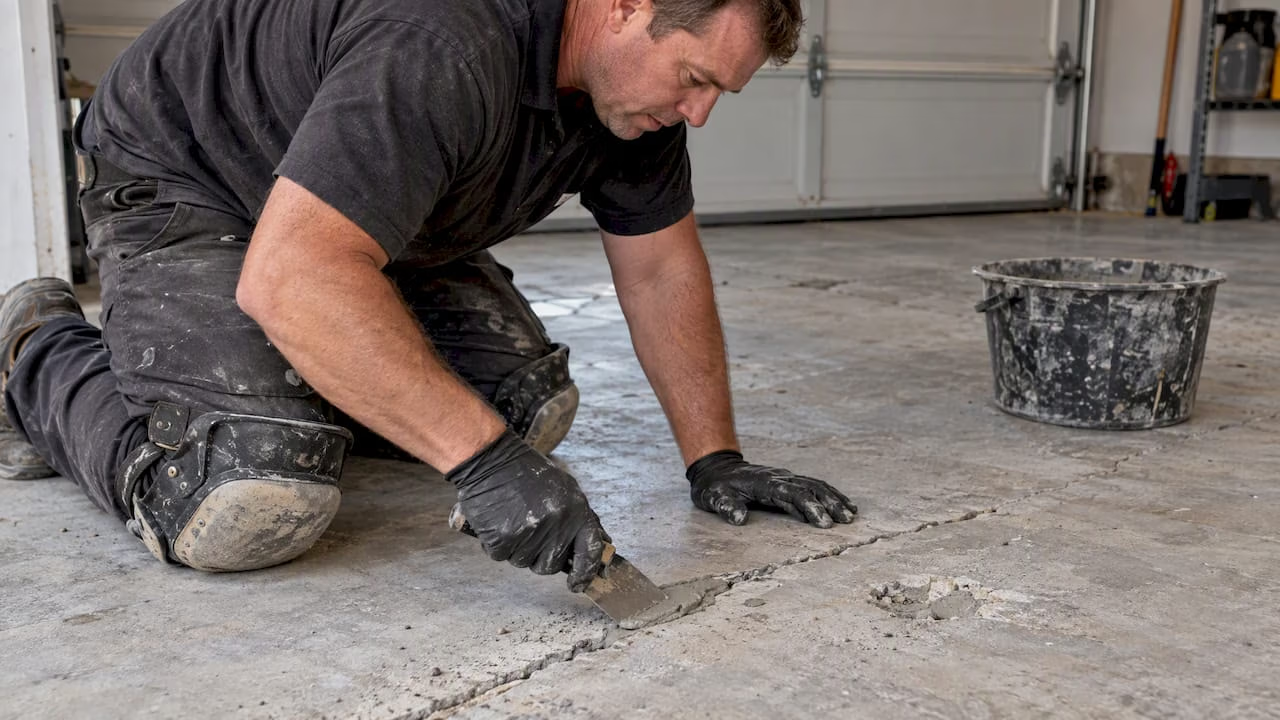
3. Repair cracks and pits
Cracks and pits are filled and leveled before any coating goes on, or they telegraph through as lines and dimples. See our concrete crack repair service for what that involves.
4. Apply the base coat and broadcast
A two-part, 100% solids epoxy goes down in a controlled thickness. While it is wet, flakes are broadcast by hand to rejection. Trade experts caution against the one-component epoxies sold to DIYers, saying they are typically not durable enough for hot tire friction, and that two-component 100% solids epoxy is the professional standard.
5. Scrape, vacuum and topcoat
After cure, we scrape off the high flakes, vacuum, and apply clear topcoat. A polyaspartic topcoat adds UV stability, chemical resistance and a hard surface that resists scuffing. Details are on our polyaspartic coatings page, and our guide to polyaspartic cure time covers when you can walk and drive on it.
Perspective: why we put prep ahead of flake color
We get asked about flake colors far more than about grinding, and we understand why. Color is the part you see. But a floor coating is an engineered system, not paint. Contractors across the trade say the same thing: the system depends on concrete that is clean, sound and dry, and many failures such as delamination come from rushed prep or ignored moisture.
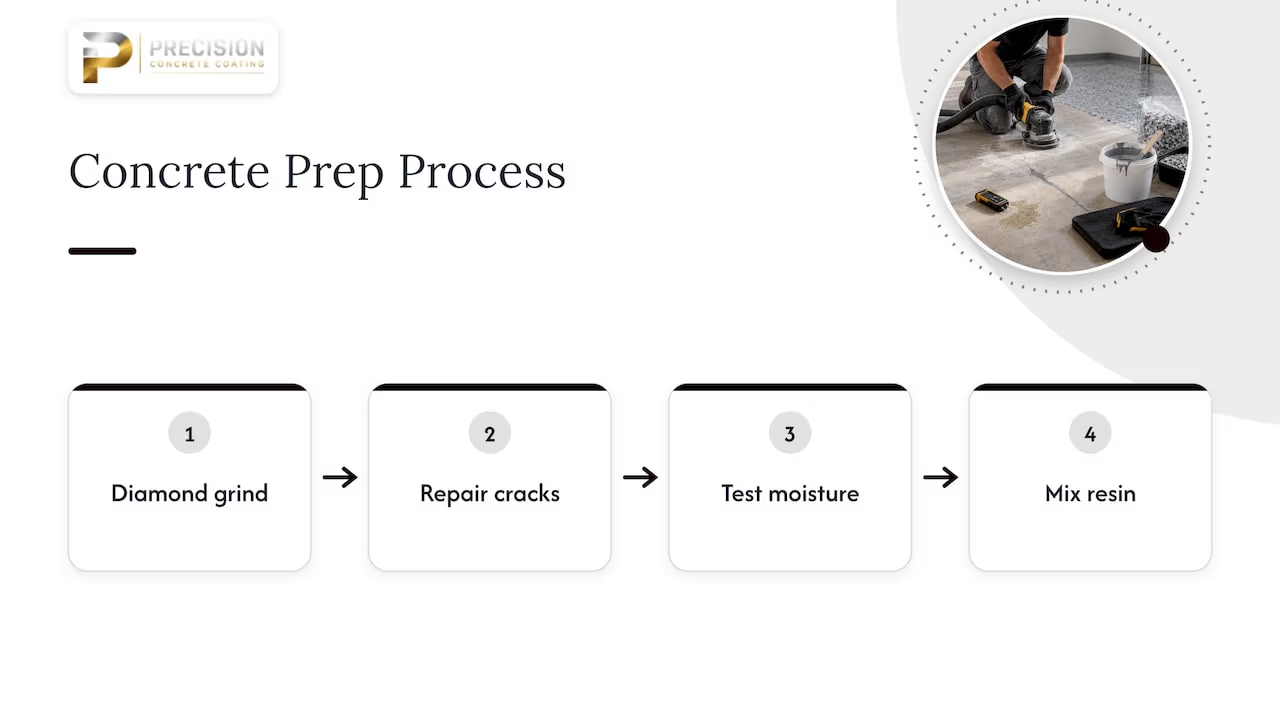
That is why we are an owner-operated company that oversees installs directly, and why our process starts with mechanical diamond grinding, crack repair and moisture testing before a drop of resin is mixed. We would rather spend an extra hour on the slab than explain a peeling floor later. It is also why we back residential installs with a 15-year warranty. We can only stand behind a floor like that because the foundation of it, the prep, is done properly.
On full flake versus partial flake, our honest view is this: for a working garage, go full flake. It forgives the slab, hides the daily mess and gives grip underfoot. Save partial flake for spaces where looks and a smoother feel outrank everything else. Either way, put your money into the prep and the topcoat first.
— William
Moisture, heat and the Texas slab
Moisture is the most common reason coatings fail. If a slab has no proper vapor retarder underneath, hydrostatic pressure can push moisture through the concrete, causing blistering and delamination. For slabs at risk, installers use moisture-mitigating epoxy primers before the decorative layers. One full flake system is even built around a moisture vapor barrier epoxy as its base coat, which shows how routine this approach is for risky slabs.
Southeast Texas adds its own challenges: humidity, hot-tire pickup, and summer heat inside a closed garage. Our write-up on pro controls for epoxy in hot climates covers how installers manage cure conditions, and airflow in an attached garage explains why ventilation matters on install day. New slab? Do not rely on the calendar alone: see epoxy on new concrete.
When a full flake floor is not the right answer
A coating cannot fix everything. A few cases to know about:
- Tile. Epoxy will not bond directly to smooth, non-porous tile. The system needs clean, mechanically profiled concrete. Our guide to epoxy over tile in home garages explains how to test moisture, then grind or remove.
- Badly damaged or very wet slabs. The same source notes that if a floor is spalling or pushing excessive moisture, a coating may fail and floating options like interlocking tiles are often suggested. We will tell you if that is your slab. For a broader look at tiles, paint and epoxy, see garage floor options compared.
- Thresholds and steps. The edge at the door takes abuse. See why we require ASTM F2170 testing before coating a threshold.
Caring for the floor after install
A full flake floor with a polyaspartic topcoat is easy to live with. Sweep or dust mop, wash with a mild pH-neutral cleaner and a soft mop or deck brush, and wipe up fluid spills when you can. Avoid harsh abrasive pads that dull the clear coat. Once the floor is in, you will probably want somewhere to put everything that used to sit on the bare slab. Wall-hung or base-style resin garage storage cabinets keep tools and chemicals off the floor, which makes cleaning faster and protects the finish from dragged metal.
Get a full flake floor quote in Conroe
If you are in Conroe or the surrounding North Houston area, we install full flake systems in residential garages with mechanical diamond prep, crack repair, moisture testing and a UV-stable polyaspartic topcoat, backed by our 15-year residential warranty. Start with our garage floor coatings page or request a written estimate through our site. You will get the scope in writing before you commit.
FAQ
What is the difference between full flake and partial flake?
A full flake floor has flakes broadcast to rejection, so the base coat is completely hidden. A partial flake floor uses fewer flakes and leaves base color visible between them. Full flake hides more flaws and gives more texture, while partial flake has a smoother, more open look.
Is a full flake floor slippery?
It is generally less slippery than a smooth, high-gloss coating because the flakes create texture. Trade contractors note that smooth glossy floors can become dangerously slippery when wet, and flake density is one way to add grip. If wet traction is critical, ask for tested wet slip-resistance data on the exact system.
How much does a full flake garage floor cost?
Nationally, professional installs run roughly $5 to $9 per square foot, with extra prep adding to that. Our published garage floor coating range is $4.50 to $7.50 per square foot, and we provide a written estimate based on your slab.
Can I install a full flake floor myself?
You can buy kits, but the results depend on grinding, moisture testing and the quality of the resin. Kits are where one-component products and acid etching often show up. We install only professionally, so we cannot guide a DIY project, but the steps above show what the work involves.
Sources
- Epoxy Flooring Cost Calculator: Free Installed Price Ranges
- Epoxy Garage Floor Coating: Cost and Which System Survives
- Trade Talk: Epoxy Coatings for Garage Floors
- MVB Poly Flake, Concrete Floor Supply
- Epoxy.com Surface Preparation Guide
- Garage Pro Fast Drying instructions, Lowe’s
- Epoxy Floor Coatings Technology Information Sheet, ITRC
- ACI 302.2-22 Guide preview, American Concrete Institute
2 Responses