
A gasoline-resistant garage floor is a concrete floor sealed with a chemical-resistant coating, usually a polyaspartic or properly installed epoxy system, so spilled fuel, oil and other fluids sit on top instead of soaking into the slab. No coating is immune to everything, and a coating only resists fuel for as long as it stays bonded to the concrete. That bond depends on surface preparation more than on the product name on the bucket.
This guide explains what “fuel resistant” and “oil resistant” mean on a garage floor, how the main coating types compare, what a Texas garage puts a floor through, and how to clean up a spill without damaging the coating. We install garage floor coatings in Conroe and the North Houston area, so we also say where a floor can fail.
TL;DR
- Bare concrete is porous. Gasoline, motor oil and brake fluid soak in, leave stains and can leave odors behind. A sealed, coated floor keeps them on the surface where you can wipe them up.
- Polyaspartic topcoats over a decorative flake system are our recommended build for a garage that sees fuel, oil and hot tires. Resistant does not mean immune, so wipe spills promptly.
- Peeling and delamination, not chemical attack, are the usual reason a garage floor coating fails. The leading cause is inadequate surface preparation, followed closely by moisture.
- Garage floor coatings with us run $4.50 to $7.50 per square foot, and our residential installs carry a 15-year warranty.
Table of Contents
- What “gasoline resistant” actually means on a garage floor
- Why bare and painted concrete lose to fuel and oil
- The coating systems compared
- What a Texas garage puts a floor through
- Why prep decides whether the floor resists anything
- Our perspective: what we see in Conroe garages
- How to handle a gas or oil spill on a coated floor
- What a gasoline-resistant floor costs
- Questions to ask before you hire a coating installer
- Ready for a floor that shrugs off spills?
- FAQ
- Sources
What “gasoline resistant” actually means on a garage floor
People search for gasoline-resistant floors, fuel-resistant epoxy, oil-resistant coatings and stain-resistant garage floors. They are all asking the same thing: if something drips or spills, will the floor survive it?
There are three separate questions inside that one.
Does the liquid soak into the concrete? Uncoated concrete is full of tiny pores. Oil wicks in and leaves a dark stain that is hard to pull out. Fuel spreads wider and thinner, and the smell can linger in the slab. A continuous coating closes those pores.
Does the coating itself get damaged? Some coatings soften, discolor or dull when a solvent sits on them. Chemical resistance depends on the resin chemistry and on how long the liquid stays in contact. A spill wiped up in minutes is a different event from a puddle left for a weekend.
Does the coating stay stuck to the floor? This is the one most homeowners miss. A coating with excellent chemical resistance still lets fuel in at the edges if it lifts, bubbles or peels. Once a coating delaminates, the protection is gone.
So when you compare products, ask about all three. A brochure that talks only about the first two is skipping the part that most often goes wrong.

Why bare and painted concrete lose to fuel and oil
The floor paint sold in big-box stores is thin. It sits in a film a fraction of the thickness of a professional system, and it is not built to take hot tires, solvents or repeated cleaning. Gas and oil can soften it, and the paint tends to lift in the tire paths first.
Garage floor tiles and mats solve a different problem. They cover the floor, but spills run through the seams and sit on the slab underneath. We cover that trade-off in more detail in our comparison of garage tiles, paint and epoxy.
Sealers are a middle option. A penetrating sealer can slow staining, but it does not give you a thick, wipe-clean surface, and it offers little protection against hot tires or impact.
The coating systems compared
Here is how the main options behave when fuel and oil are part of normal garage life.
| System | Spill and fuel behavior | Hot tires | UV in sunlit garages | Notes |
|---|---|---|---|---|
| Solid-color epoxy | Good barrier when properly installed and bonded | Can soften or lift under hot tires | Can amber or yellow with sun exposure | Lower material cost, longer cure |
| Epoxy base with full-flake broadcast | Flakes add texture and hide drips; the clear topcoat does the sealing | Depends on topcoat | Depends on topcoat | Strong look, hides dirt |
| Epoxy or polyaspartic base, flake, polyaspartic topcoat | Our standard recommendation for fuel and oil exposure | Built to resist hot-tire pickup | UV-stable | Fast return to service |
| Metallic epoxy | Seals the slab, glossy and decorative | Topcoat choice matters | Topcoat choice matters | Best for show garages and showrooms |
| Polished concrete | Densified surface, not a thick film; can still stain without a sealer | Handles hot tires well | No issue | Fits some homes, see below |
The pattern is that the topcoat is where the chemical and heat resistance lives. That is why we pair decorative flake floors with a UV-stable polyaspartic finish. You can read about the topcoat itself on our polyaspartic coatings page and see the decorative side on our decorative flake garage floors page.
Polished concrete deserves honesty. It looks clean and holds up well to traffic, but it is a ground and densified surface rather than a sealed film, so spill protection depends on the sealer used. If you want to understand when it fits a home garage, see when polished concrete makes sense.
Epoxy or polyaspartic for fuel resistance?
Both are used in professional garage floors. Epoxy is a tough, thick base resin that bonds well to properly profiled concrete. Polyaspartic is typically used as a clear topcoat because it cures quickly, tolerates sunlight and stands up well to heat. When a reader searches for fuel-resistant epoxy, what they usually need is an epoxy base for build and bond, protected by a topcoat that resists fuel, heat and sun.
Cure time matters in a working garage. With the right system you can be driving on the floor far sooner than with a traditional epoxy build. Our guide to polyaspartic cure time explains what the 24-hour window assumes.
What a Texas garage puts a floor through
Southeast Texas is hard on garage floors for reasons that have nothing to do with fuel.
- Heat. Tires come in hot after a drive on summer roads, and the garage itself can get hot. Heat is what separates a coating that handles tires from one that peels in the tire path.
- Humidity and moisture. Slabs in humid regions carry moisture vapor that pushes up from below. A floor that looks dry can still release enough vapor to lift a coating.
- Sun through open doors. Garage doors left open expose the floor edge to UV, which can yellow epoxy that lacks a UV-stable topcoat.
- Attached-garage air. Fumes and ventilation matter during installation. Our note on epoxy in an attached garage covers it.
None of these show up in a chemical resistance chart, but each can end a coating’s life before the first fuel spill does.
Why prep decides whether the floor resists anything
The coating’s data sheet describes how the cured film behaves. It says nothing about whether the film is attached to your slab. That depends on the work done before any resin is mixed.
The American Concrete Institute’s guide on surface preparation for protection systems says that the manufacturer will typically specify the prepared surface condition, including surface profile, moisture level and crack acceptability. Missing those specs can void a manufacturer’s warranty and lead to delamination. Mechanical grinding gives the coating a rough anchor to grip. Acid etching alone often does not.
That is why every floor we coat starts with mechanical diamond grinding. After that we repair cracks and pitting, because an open crack is a path for fuel to reach the slab and for moisture to push the coating up. Our concrete crack repair page describes the process.
Moisture testing comes before coating
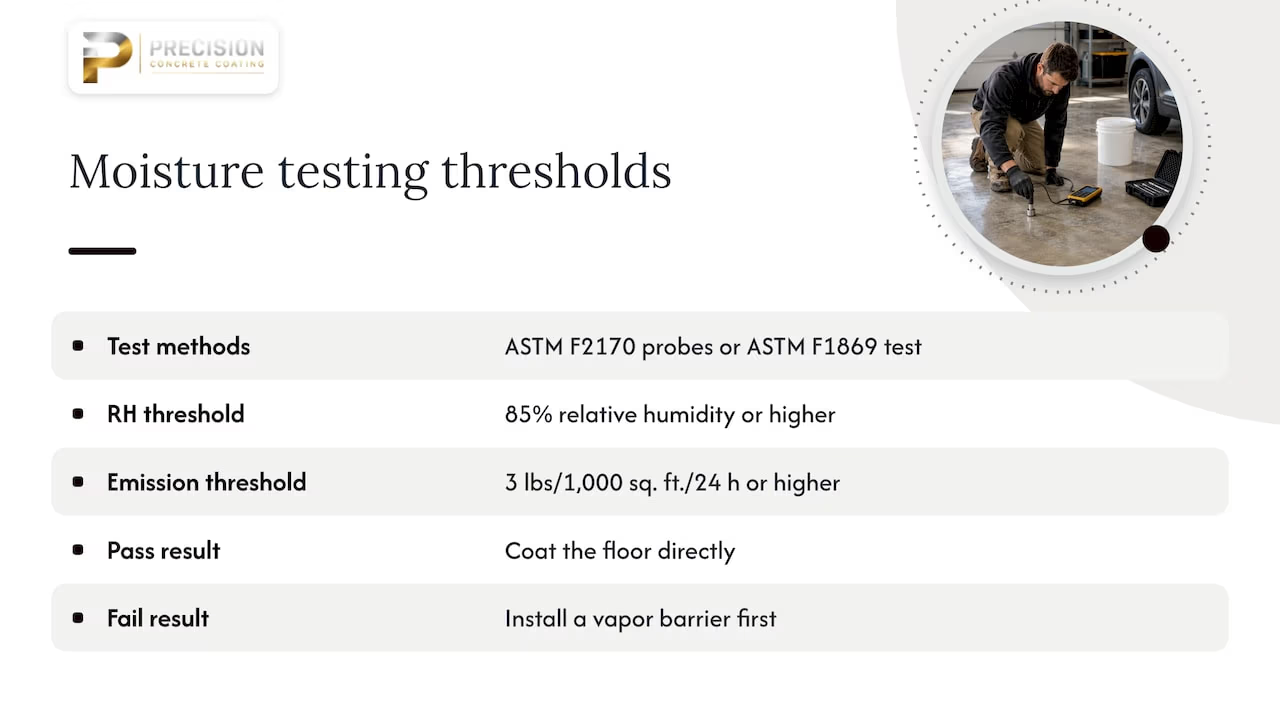
Moisture is the other big failure cause. Application guidance from Euclid Chemical calls for testing with either ASTM F2170 in-situ probes or the ASTM F1869 calcium chloride test. It says that a reading of 85% relative humidity or 3 lbs per 1,000 sq. ft. per 24 hours or higher calls for a moisture mitigation system before coating, to prevent delamination.
In practice, that means a floor that passes the test can be coated directly, and a floor that fails needs a vapor barrier layer first. Skipping the test is how a good coating ends up peeling in sheets. If you want a quick homeowner check before you talk to anyone, see our two simple moisture tests under epoxy. For the contractor side, there is a moisture mitigation checklist.
There is a structural reason too. Slabs built correctly have a gravel capillary break and a plastic vapor retarder beneath them, as the Department of Energy’s building science material describes: at least 4 inches of aggregate and 6-mil polyethylene sheeting. Many older garage slabs do not have that protection, which is why testing the actual slab matters more than assuming.
New slabs have their own rules, and waiting 28 days is not a guarantee. See epoxy on new concrete.
Our perspective: what we see in Conroe garages
We are an owner-operated local company, and the question we hear most is whether a coating will “hold up to gas and oil.” Our honest answer is that the chemistry of a good topcoat is rarely the problem. The floors we get called to fix failed because the slab was not ground, a crack was painted over, or moisture was never tested.
That is why our process puts preparation first: mechanical diamond grinding, crack and pitting repair, and moisture testing before any coating goes down. Then we build the system for the way you use the garage. For a garage that parks daily drivers, handles the occasional oil drip and sees hot tires, we lean toward decorative flake with a UV-stable polyaspartic topcoat. Flake hides the small marks that real garages collect, and the topcoat gives you a surface you can wipe clean.
We would rather tell you a floor needs moisture work first than coat over a problem. A coating laid on a damp, poorly prepared surface is the kind of job we hope you never have to pay to redo, and it is why we stand behind residential installs with a 15-year warranty.
— William
How to handle a gas or oil spill on a coated floor
A coating buys you time, not permission to ignore a spill. These steps protect both the coating and your safety.
- Remove ignition sources and ventilate. Gasoline vapor is flammable. Open the garage door, keep pilot flames, sparks and running equipment away, and do not use the area as normal until the vapors clear.
- Contain and absorb. The EPA’s guidance for garages recommends absorbent materials such as clay-based kitty litter for petroleum spills and says floor drains should be managed so contaminants do not reach groundwater.
- Wipe up fast. Most coatings tolerate a short contact time with fuel far better than a puddle left for days.
- Clean with a mild degreaser, then rinse and dry. Skip harsh solvents on the coating.
- Dispose of soaked absorbent properly. Fuel-soaked rags and absorbent should not go in household trash without checking your local household hazardous waste rules. In Montgomery County, contact the county or your city for current collection options.
If a fuel smell spreads from the garage into a vehicle after a spill or leak, an interior approach such as this step-by-step guide to removing gasoline smell from a car can help with the car side of the problem. It is a vehicle detailing guide, written for the Phoenix area, and it does not replace safe handling of the spill on your floor.
For ongoing care, a soft push broom and a neutral cleaner are enough. Jack stands and floor jacks can mar any coating, so use pads or plywood; see our note on jack marks on epoxy floors.
What a gasoline-resistant floor costs
For garage floor coatings, our published pricing is $4.50 to $7.50 per square foot. A typical two-car garage is a few hundred square feet, so your final number depends on the size, the condition of the slab, the amount of crack repair, any moisture mitigation and the system you choose. Patio and pool deck coatings run $5.00 to $8.00 per square foot, and general concrete coating runs $4 to $8 per square foot. You get a written estimate before any work begins, and the details are on our coating cost and estimates page.
Compare quotes on what is included, not just the per-foot number. Ask whether the price covers diamond grinding, crack repair, moisture testing and the topcoat type. A low bid that skips those is a bid that is cheap for a reason.
Questions to ask before you hire a coating installer
- How will you prepare the slab: diamond grinding or acid etching?
- Will you test moisture with ASTM F2170 or F1869 before coating, and what happens if the slab fails?
- What topcoat goes on, and is it UV-stable?
- How are cracks and pitting repaired?
- Who does the work, and who stands behind it?
- What does the warranty actually cover, and is it in writing?
Ready for a floor that shrugs off spills?
If you are in Conroe or the surrounding North Houston area, we install full-flake systems, solid-color epoxy, metallic finishes and polyaspartic topcoats on residential garages. Start with our garage floor coatings in Conroe page, or contact us through our site for a written estimate.
FAQ
Is epoxy gasoline resistant?
A properly installed epoxy coating forms a barrier that keeps gasoline from soaking into the concrete. The usual weak points are hot tires and sun exposure, which is why we add a UV-stable polyaspartic topcoat. Wipe spills promptly either way.
Will a coating stop gas and oil stains completely?
A sealed floor keeps spills on the surface, so they wipe away instead of leaving a stain in the slab. Resistant is not the same as immune, and a long-neglected puddle can still mark a coating. Prompt cleanup is part of the deal.
Can I put a fuel-resistant coating over an already stained floor?
Usually yes, after the slab is mechanically ground and cleaned. Deep oil contamination can interfere with the bond, so a professional should inspect the floor and test moisture first.
Is polyaspartic better than epoxy for a garage?
For a garage that sees hot tires, sun and fuel, polyaspartic is a strong topcoat because it is UV-stable and cures fast. Many of our systems use epoxy or polyaspartic for build and polyaspartic on top. The right choice depends on your slab and how you use the space.
Why do some garage floor coatings peel?
Most peeling traces back to inadequate surface preparation or untested moisture in the slab. Mechanical grinding, crack repair and moisture testing before coating are what prevent it.
Sources
- ACI 515.3R-20: Guide for Assessment and Surface Preparation for Application of Protection Systems for Concrete
- Euclid Chemical: Epoxy and Urethane Coatings Application Guide
- U.S. Department of Energy: Capillary Break Beneath Slab
- EPA: Floor Cleanup, Best Environmental Practices for Auto Repair and Vehicle Fleet Maintenance